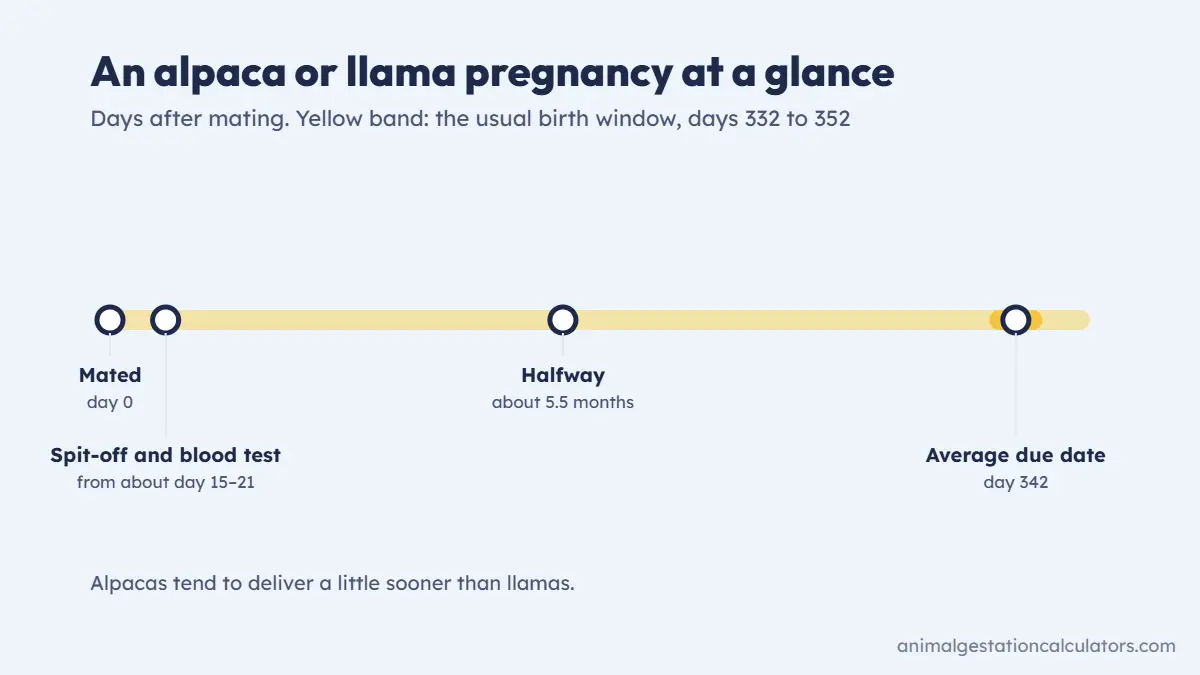
Quick answer: The alpaca gestation period is about 11.5 months, or roughly 342 days. Llamas carry for about the same time, and most females give birth between day 332 and day 352 after mating. Enter the mating date above to get the due date and the window to watch.
Alpaca gestation period: how long are alpacas and llamas pregnant?
Both carry their young, called a cria, for about 11.5 months. The average is about 342 days. Alpacas tend to deliver a few days sooner than llamas, so treat the date as a guide rather than a deadline.
| Days after mating | Weeks | Months | What it means |
|---|---|---|---|
| 332 days | About 47 | About 11 | Start of the usual window |
| 342 days | About 49 | About 11.5 | Average length |
| 352 days | About 50 | About 11.5–12 | End of the usual window |
Why is the mating date so reliable for camelids?
Alpacas and llamas are induced ovulators. That means mating itself triggers the release of an egg, about 24 to 30 hours later. Unlike a dog or a horse, she does not have to be at a set point in a cycle.
So if you saw the mating, you know almost to the day when the pregnancy began. If she was mated more than once, use the last mating that was followed by a rejected male, since that is the one most likely to have worked.
Are alpacas and llamas different?
| Alpaca | Llama | |
|---|---|---|
| Average pregnancy | About 11.5 months, slightly shorter | About 11.5 months |
| First breeding | After about 24 months and 40 kg (88 lb) | After about 24 months and 90 kg (198 lb) |
| Cria birth weight | 5.5–8 kg (12–18 lb) | 11–16 kg (24–35 lb) |
| Crias per birth | One | One |
Both carry far longer than sheep, which lamb after about 147 days. Females start cycling at about 10 to 12 months, but breeding is usually held off until she reaches the age and weight above. A small, young female has a harder time with pregnancy and birth.
How can you tell if an alpaca or llama is pregnant?
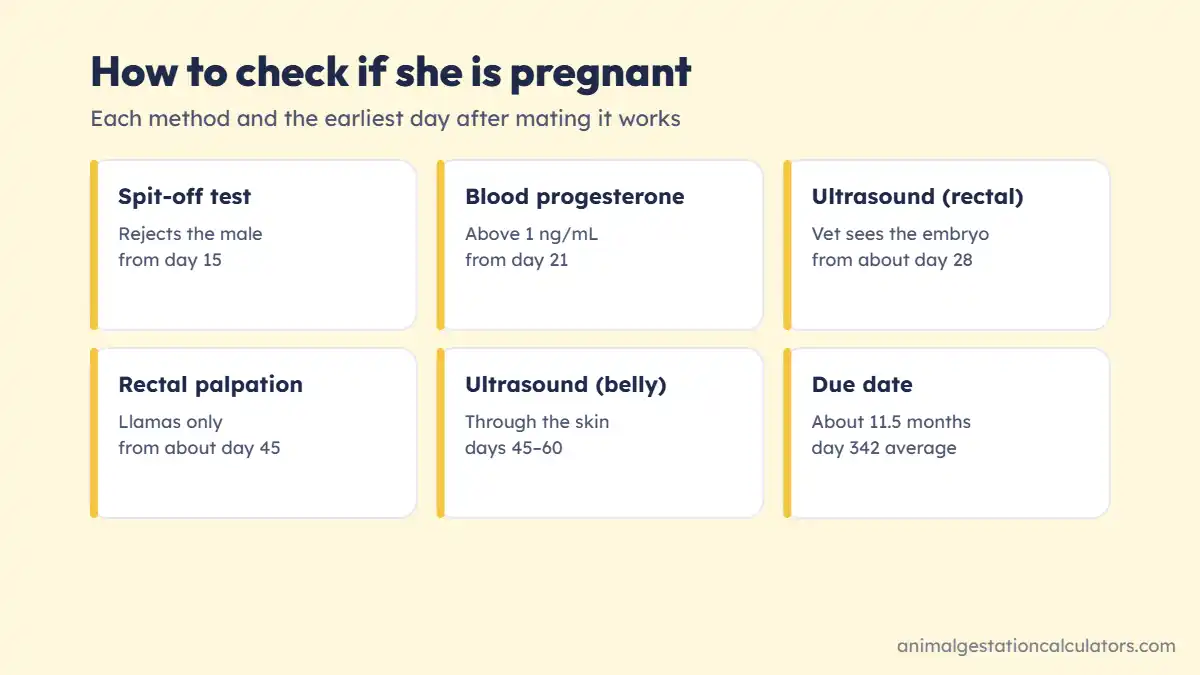
There are four common checks. Each works from a different day after mating:
- Spit-off test (from about day 15): bring the male back. A pregnant female usually refuses him by spitting, kicking or running off. It is a good first sign, but a female can reject for other reasons.
- Progesterone blood test (from day 21): a level above 1 ng/mL means she has an active corpus luteum, the structure that keeps a pregnancy going. False positives happen if that structure lingers without a pregnancy.
- Ultrasound through the rectum (from about day 28): your vet can see the embryo directly. This is the most certain early check.
- Ultrasound on the belly (days 45 to 60): less invasive and easy to do on the farm.
In llamas, a vet can also feel the uterus through the rectum after about day 45. This is usually not safe in alpacas because of their size.
Can alpacas or llamas have twins?
Almost never. Twin pregnancies sometimes start, but they are usually lost early. Live twin births are extremely rare, so expect one cria.
What does birth look like?
Most crias arrive in the morning. More than 70% of births happen before midday, which gives the cria time to dry and nurse in the warm part of the day.
| Stage | What happens | Normal length |
|---|---|---|
| Stage 1 | She hums more, pees often and moves away from the herd | 1 to 6 hours |
| Stage 2 | Pushing and delivery of the cria | Usually under 30 minutes |
| Stage 3 | The afterbirth comes out | Within 4 to 6 hours |
First-time mothers usually take longer at every stage. Difficult births are not common, but call your vet if strong pushing goes past 30 minutes with no progress, or if the afterbirth has not come out by 6 hours.
There are few reliable signs that birth is close, so start daily checks once she reaches day 330.

How soon can she be bred again?
Most females can conceive again 14 to 21 days after giving birth. Many breeders aim for this so the herd keeps a once-a-year birth pattern. Make sure she is in good body condition and the cria is nursing well first.
Alpaca and llama due date table
Find the mating date in the first column. The second column shows the 342-day average, and the third shows the usual window.
| Bred on | Due date | Normal window |
|---|---|---|
| Jan 1 | Dec 9 | Nov 29 – Dec 19 |
| Jan 15 | Dec 23 | Dec 13 – Jan 2 |
| Feb 1 | Jan 9 | Dec 30 – Jan 19 |
| Feb 15 | Jan 23 | Jan 13 – Feb 2 |
| Mar 1 | Feb 6 | Jan 27 – Feb 16 |
| Mar 15 | Feb 20 | Feb 10 – Mar 1 |
| Apr 1 | Mar 8 | Feb 27 – Mar 18 |
| Apr 15 | Mar 22 | Mar 12 – Apr 1 |
| May 1 | Apr 7 | Mar 28 – Apr 17 |
| May 15 | Apr 21 | Apr 11 – May 1 |
| Jun 1 | May 8 | Apr 28 – May 18 |
| Jun 15 | May 22 | May 12 – Jun 1 |
| Jul 1 | Jun 7 | May 28 – Jun 17 |
| Jul 15 | Jun 21 | Jun 11 – Jul 1 |
| Aug 1 | Jul 8 | Jun 28 – Jul 18 |
| Aug 15 | Jul 22 | Jul 12 – Aug 1 |
| Sep 1 | Aug 8 | Jul 29 – Aug 18 |
| Sep 15 | Aug 22 | Aug 12 – Sep 1 |
| Oct 1 | Sep 7 | Aug 28 – Sep 17 |
| Oct 15 | Sep 21 | Sep 11 – Oct 1 |
| Nov 1 | Oct 8 | Sep 28 – Oct 18 |
| Nov 15 | Oct 22 | Oct 12 – Nov 1 |
| Dec 1 | Nov 7 | Oct 28 – Nov 17 |
| Dec 15 | Nov 21 | Nov 11 – Dec 1 |
Frequently asked questions
How many months is an alpaca pregnant?
About 11.5 months. Most alpacas give birth between 11 and 12 months after mating.
Can she go past the due date?
Yes. Day 342 is only an average, and some healthy females deliver after day 352. Ask your vet to check her if she passes day 360 or seems unwell.
Can llamas and alpacas mate?
Yes. A llama and an alpaca can breed, and the cross is called a huarizo. Plan around the mother’s species, and expect a similar 11.5-month wait.
Do alpacas give birth at night?
Rarely. Most crias are born in the morning or around midday. A female in labor late in the day is worth watching closely.
Should I keep the male away during pregnancy?
Yes, apart from short spit-off tests. Repeated mating attempts stress her and are not needed once she is confirmed pregnant.
How does this compare with a horse or donkey?
It sits between them. A mare carries for about 11 months, as our horse gestation calculator shows, and a donkey carries for about 12 months. Our animal gestation chart lists every species side by side.