Quick answer: A mare in heat is in the fertile part of her cycle. Horses come into heat about every 21 days from spring to early fall, and each heat lasts about 4 to 7 days. Enter the first day of her last heat below to see when the next ones are due.
Tip: if you have dates from her past heats, pick her own gap.
Next heat expected
Pick a date
Heat usually lasts 4 to 7 days.
Most mares cycle from spring to early fall. In winter many stop cycling.
What happens when a mare is in heat?
Heat, or estrus, is the part of her cycle when she will accept a stallion. A follicle on her ovary grows and makes estrogen. That hormone changes her behavior and readies her body to ovulate.
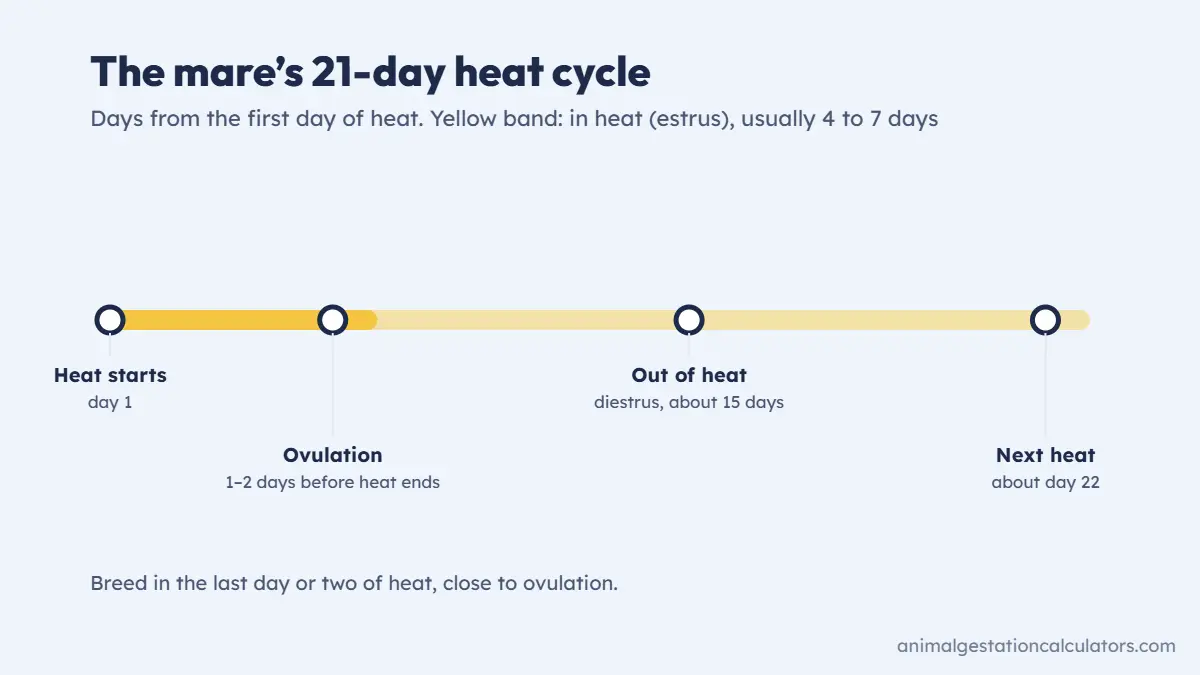
She releases the egg about 24 to 48 hours before her heat ends. Then she goes out of heat for about two weeks while her body waits to see if she is pregnant. If she is not, the cycle starts again.
How long is a horse in heat, and how often?
The full horse heat cycle takes about 21 days. Normal cycles run 18 to 24 days. It splits into two parts:
| Phase | Typical length | What is going on |
|---|---|---|
| In heat (estrus) | About 4 to 7 days | She is receptive. Ovulation comes near the end. |
| Out of heat (diestrus) | About 14 to 15 days | She rejects the stallion while her body waits to see if she is pregnant. |
Heats are often longer early in spring and shorter in midsummer. Track her own dates for a few cycles, then set the calculator to her usual gap.
When do mares come into heat?
Horses are seasonal breeders, and day length controls the season, not temperature. Longer spring days lower a hormone called melatonin, which switches her ovaries back on.
- Winter: most mares stop cycling. This rest is called anestrus.
- Early spring: a transition period. Heats can be long, irregular and often without ovulation.
- Mid-spring to late summer: regular 21-day cycles. This is the natural breeding season.
- Fall: cycles become irregular again, and then stop.
Some mares keep cycling all winter, especially in mild climates or under stable lights.
What are the signs a mare is in heat?
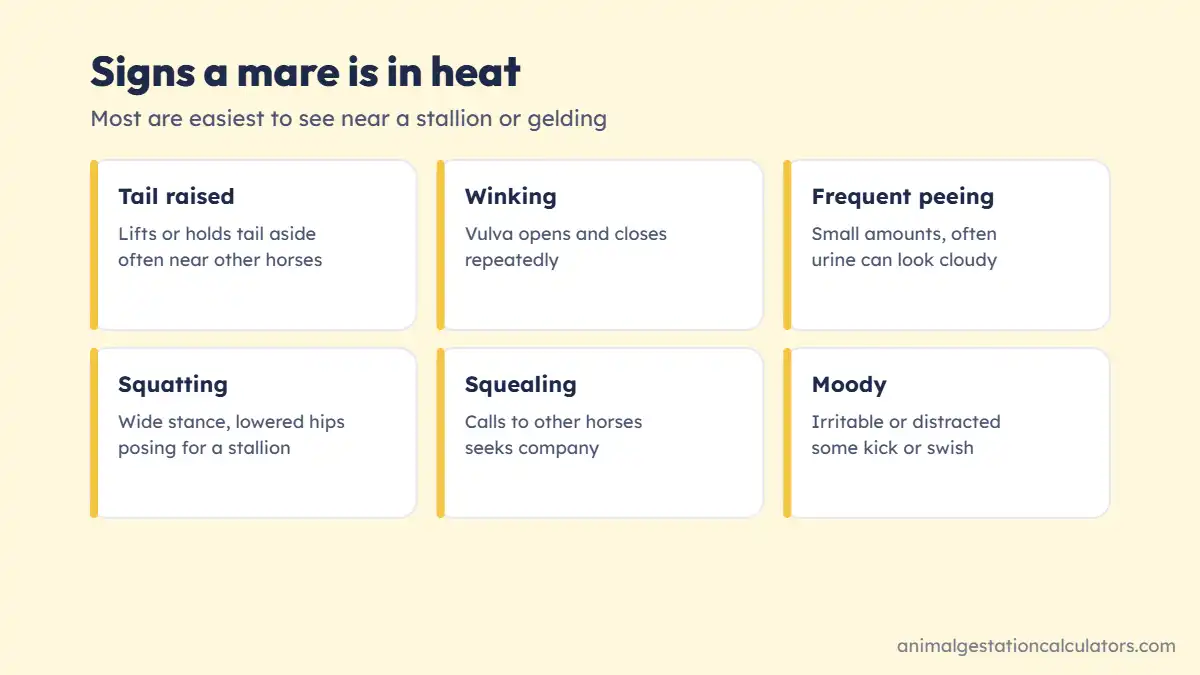
A mare in heat often shows these signs, most clearly when she can see or smell a stallion or gelding:
- Raising her tail or holding it to one side
- “Winking,” where the vulva opens and closes again and again
- Peeing small amounts often
- Squatting with her back legs apart
- Squealing and seeking out other horses
- Being more moody, distracted or touchy than usual
Some mares show almost nothing. This “silent heat” is normal for them, and a vet can still track her cycle with an ultrasound.
What do mares squirt when in heat?
It is urine, often mixed with mucus. That is why it can look thick, cloudy or yellow. Squirting small amounts while posing is a normal heat signal that tells a stallion she is ready.
What else can look like heat?
Not every grumpy mare is in heat. Rule out these first:
- Submissive behavior. A low-ranking mare may squirt urine, lean away and swish her tail when she feels threatened. It looks like heat but is not hormonal.
- Pain. Back, saddle-fit or hoof pain can show up as tail swishing and kicking.
- Discharge from the vulva. Thick mucus or pus can mean a uterine infection.
- Stallion-like behavior. Mounting, biting or striking other mares can point to an ovarian tumor or to hormones from supplements or medicines.
A detailed diary helps. If her bad days do not line up with a roughly three-week pattern, ask your vet to look for another cause.
Can you ride a mare in heat?
Yes. Heat is not an illness, and most mares can be ridden and worked as normal. Some are more distracted or sensitive for a few days. These tips help:
- Keep her away from stallions and, if needed, geldings she is attached to.
- On group rides, keep her toward the back.
- Allow a longer warm-up and keep sessions short and simple on her hardest days.
- Plan important shows using her cycle diary where you can.
How can you calm a mare in heat?
Start with management: a steady routine, turnout with calm companions and distance from stallions. If her heat behavior is severe or affects safety, your vet can suggest options. These include a daily progesterone-type medicine (altrenogest), progesterone injections or other hormone treatments.
Altrenogest must be handled with gloves. It can affect people who get it on their skin, especially women who are or may be pregnant. Removing the ovaries is a last resort.
When should you breed a mare?
She ovulates near the end of her heat, so breeding in the last day or two of heat gives the best chance. Many breeders work with a vet who checks the follicle by ultrasound to time breeding closely.
After foaling, most mares come into a “foal heat” within one to two weeks. Once she is bred, our horse gestation calculator gives you the foaling date. Donkey jennies cycle slightly longer, as the donkey gestation guide explains.
Frequently asked questions
How many days is a mare in heat?
Usually 4 to 7 days. Early-spring heats can be longer, sometimes 10 days or more. A cow in heat, by contrast, stands for less than a day.
Can a mare get pregnant when not in heat?
Very rarely. She only accepts the stallion and ovulates during heat. Outside heat, she usually rejects him.
Do mares bleed when they are in heat?
No. Unlike dogs, mares do not bleed during heat. Blood from the vulva needs a vet check.
At what age do mares start coming into heat?
Most fillies begin cycling between about 1 and 2 years old, usually in the spring or summer after their first birthday.
Why is my mare in heat all the time?
In early spring, long and irregular heats are normal. Outside that time, constant heat behavior can point to pain, an ovarian problem or a hormone issue. Ask your vet to check her.
Does heat affect a mare’s performance?
For some mares, yes, for a few days. Many show no change. A cycle diary tells you which kind of mare you have.