Quick answer: Goats go into heat about every 21 days during breeding season, which in most of the U.S. runs from late summer or fall into winter. A goat in heat stays receptive for 24 to 48 hours, about 36 hours on average. Enter the first day of her last heat below to see when her next heats are due.
Tip: if you have dates from her past heats, pick her own gap.
Next heat expected
Pick a date
Heat usually lasts 24 to 48 hours (about 36 on average).
Most does cycle from late summer or fall into winter. Young does often have shorter cycles.
How often do goats go into heat?
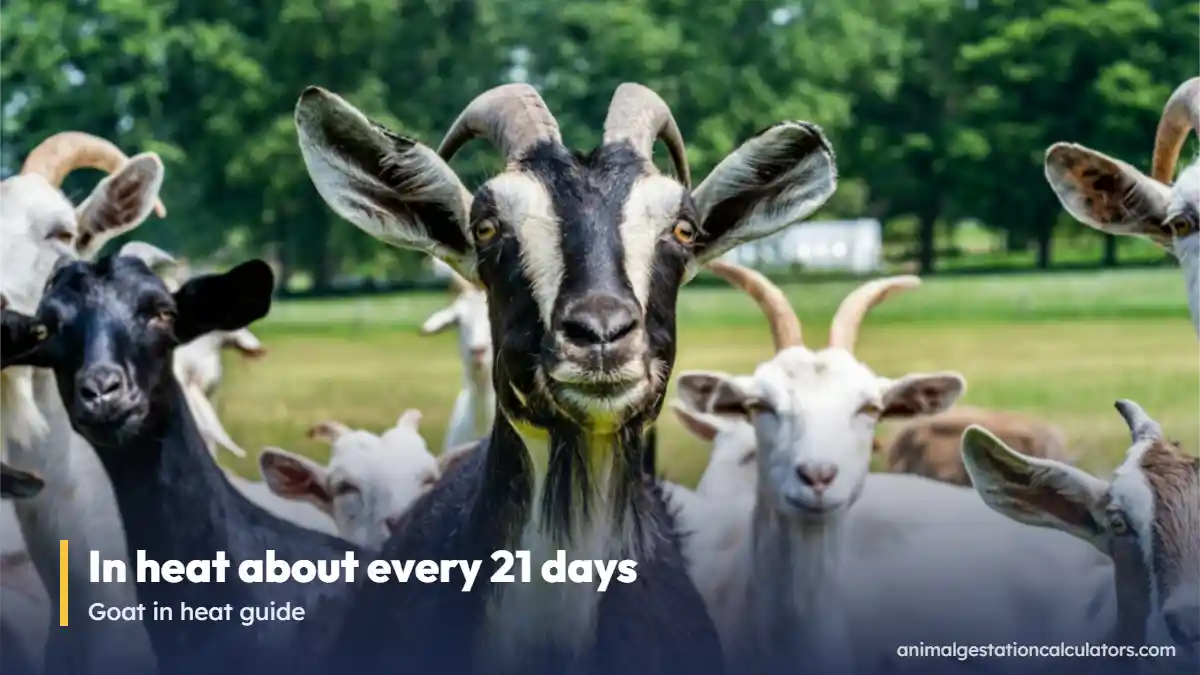
A doe that is not pregnant comes back into heat about every 21 days, as long as she is in breeding season. The exact gap varies with breed, age and the time of year.
Goats also have a lot of short cycles. Young does and does early in the season often come back into heat after only 5 to 7 days. Later in the season, cycles can stretch longer as she heads toward her rest period. If her gaps look odd, keep a diary for a few cycles and set the calculator to her real pattern.
When is goat breeding season?
Most goats are seasonal breeders. Shorter days in late summer and fall trigger their heats, so kids arrive in spring when there is plenty of food.
- Late summer to fall: heats begin and are at their peak.
- Winter: heats taper off.
- Spring and early summer: most does rest and do not cycle.
Some breeds bred near the equator, and goats kept in warm climates with steady day length, can cycle much more of the year. Many Nigerian Dwarf and Pygmy owners see heats outside the usual season.
How long is a goat in heat?
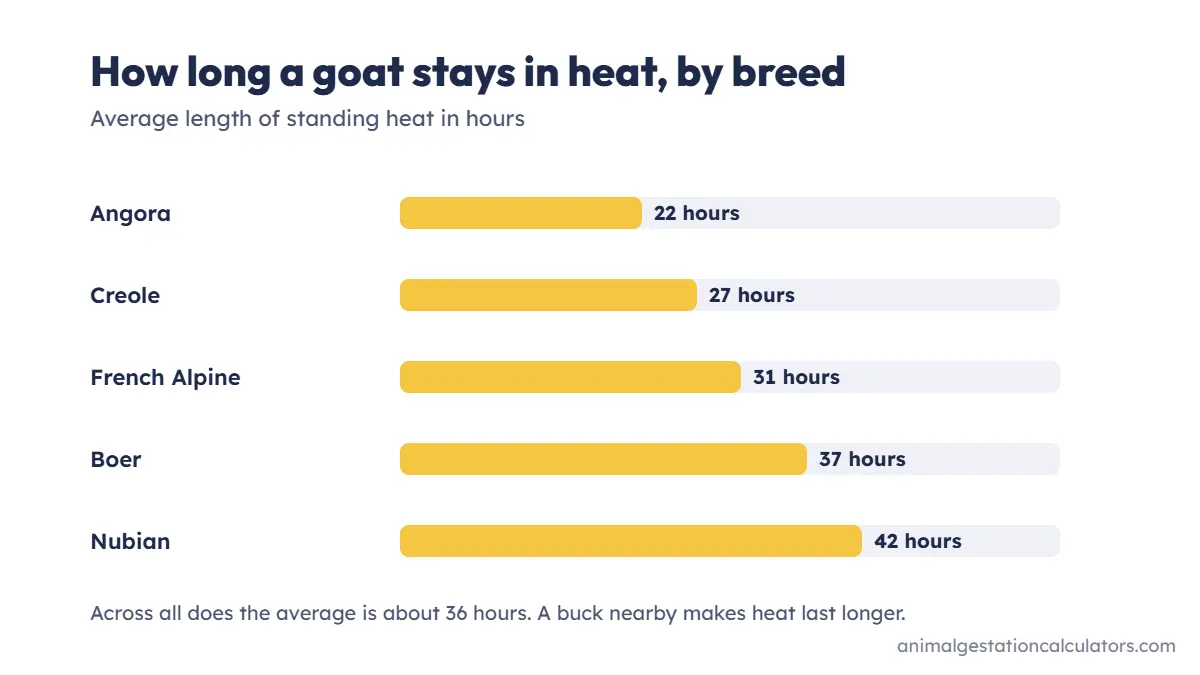
Standing heat lasts 24 to 48 hours, with an average of about 36. Breed plays a big part. Published averages range from 22 hours in Angora goats to 42 hours in Nubians.
Heats also run longer when a buck is close by, and young does tend to have shorter heats than mature ones.
What are the signs of a goat in heat?
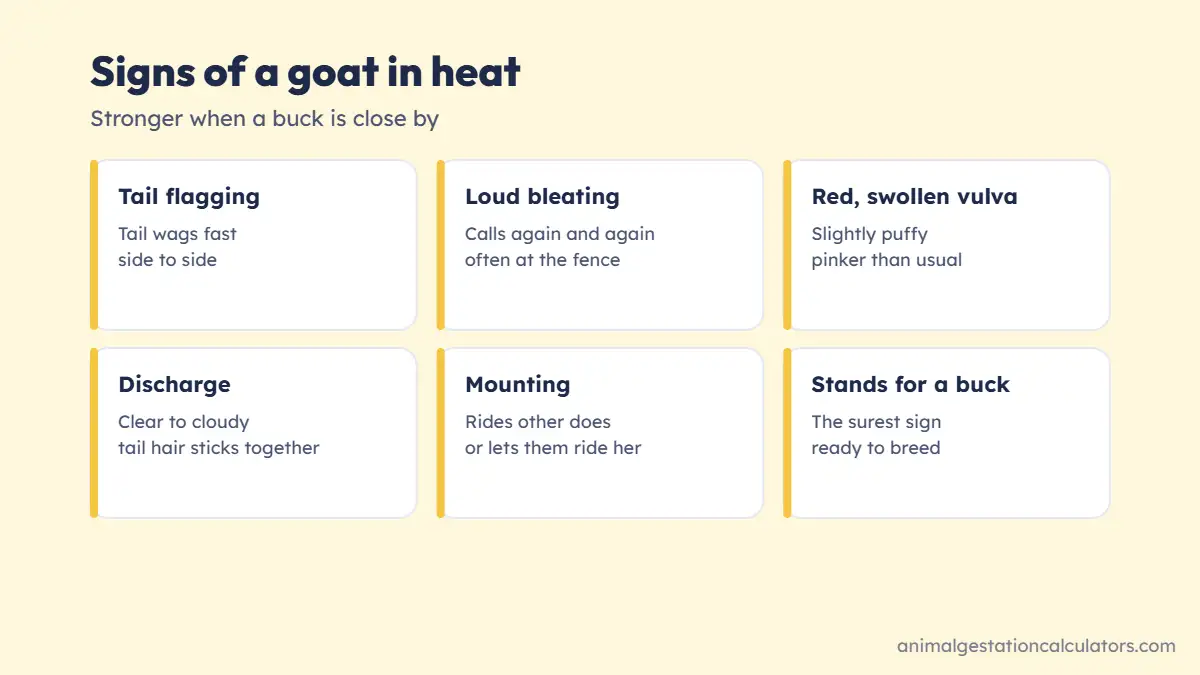
A goat in heat, also called a doe “in season,” usually shows several of these signs:
- Flagging: wagging her tail fast from side to side
- Loud, frequent bleating, often near the fence or the buck pen
- A red, slightly swollen vulva
- Clear to cloudy discharge that makes her tail hair stick together
- Mounting other does, or letting them mount her
- Peeing often, especially near a buck
- Eating less and being restless
- Standing still for the buck, which is the surest sign
These signs are much stronger when she can smell a buck. A “buck rag,” a cloth rubbed on a buck and kept in a sealed jar, can help bring out signs in a herd with no buck.
When should you breed a goat in heat?
A doe usually ovulates toward the end of standing heat, anywhere from 9 to 72 hours after heat starts. Breeding about 12 to 24 hours after you first notice heat, or simply leaving her with the buck for the whole heat, covers that window.
Once she is bred, write down the date. Our goat gestation calculator turns it into a kidding date.
When do goats go into heat for the first time?
Most does reach puberty at 6 to 8 months old. Some small breeds, such as Pygmy goats, can come into heat as early as 3 months. Bucklings can be fertile at 4 to 6 months, so separate young bucks from does early.
Being able to get pregnant is not the same as being ready. Wait until she reaches at least 60% of her adult weight. For larger dairy and meat breeds, such as Nubian, LaMancha, Boer and Saanen, that is about 70 pounds (32 kg).
How can you help does come into heat?
- Feed for condition. Thin does cycle poorly. A short boost in feed about two weeks before and after breeding, called flushing, can raise the number of eggs she releases. It works best in does in average or lean condition, not in fat ones.
- Use the buck effect. Bringing a buck near does that have been apart from him can trigger heats.
- Keep good records. Dates from past heats are the best predictor of the next one.
If a doe shows no heat at all during the season, ask your vet to check for pregnancy, poor condition or an ovarian problem.
Frequently asked questions
How many times a year does a female goat go into heat?
Every 21 days or so during breeding season, so often five to eight times in a season if she is not bred. Does in warm climates may cycle for more of the year.
Do female goats have to be in heat to get pregnant?
Yes. A doe only ovulates and accepts a buck during heat. Outside heat, she usually refuses him.
What is a goat in heat called?
She is said to be “in heat,” “in season” or in estrus. A doe showing the classic tail wag is often called “flagging.”
Do goats bleed when in heat?
No. Clear or cloudy discharge is normal during heat. Blood from the vulva is not a normal heat sign, so ask your vet to check her.
Can a pregnant goat show signs of heat?
Some do, especially in the first few weeks. Do not assume a heat means she is open. A blood test or ultrasound can confirm pregnancy.
How do sheep compare with goats?
Ewes are also fall breeders with a cycle of about 17 days, a little shorter than a goat’s. See the sheep gestation calculator for lambing dates, or the cow heat cycle guide for cattle.