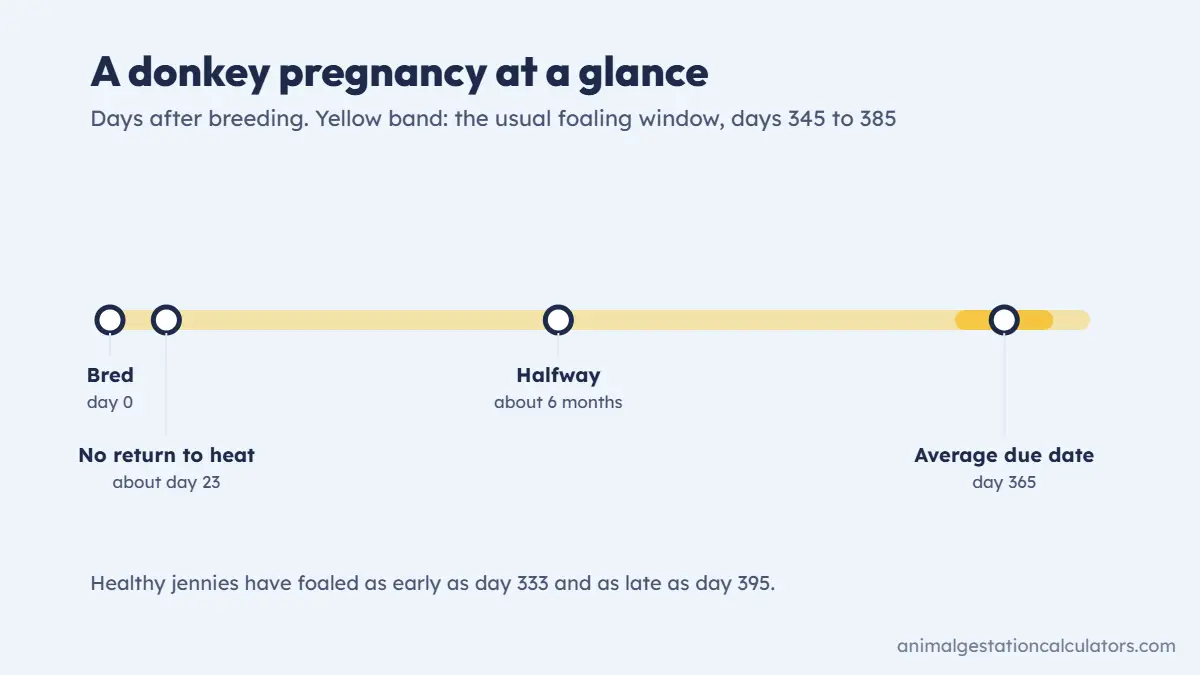
Quick answer: The donkey gestation period is about 365 days, or 12 months. Most jennies foal between day 345 and day 385 after breeding, and some healthy foals arrive even later. Enter the breeding date above to get her foaling date and the full window to watch.
Donkey gestation period: how long is a donkey pregnant?
A donkey is pregnant for about a year. The average is 365 days, which is close to 52 weeks. That is roughly three weeks longer than a horse.
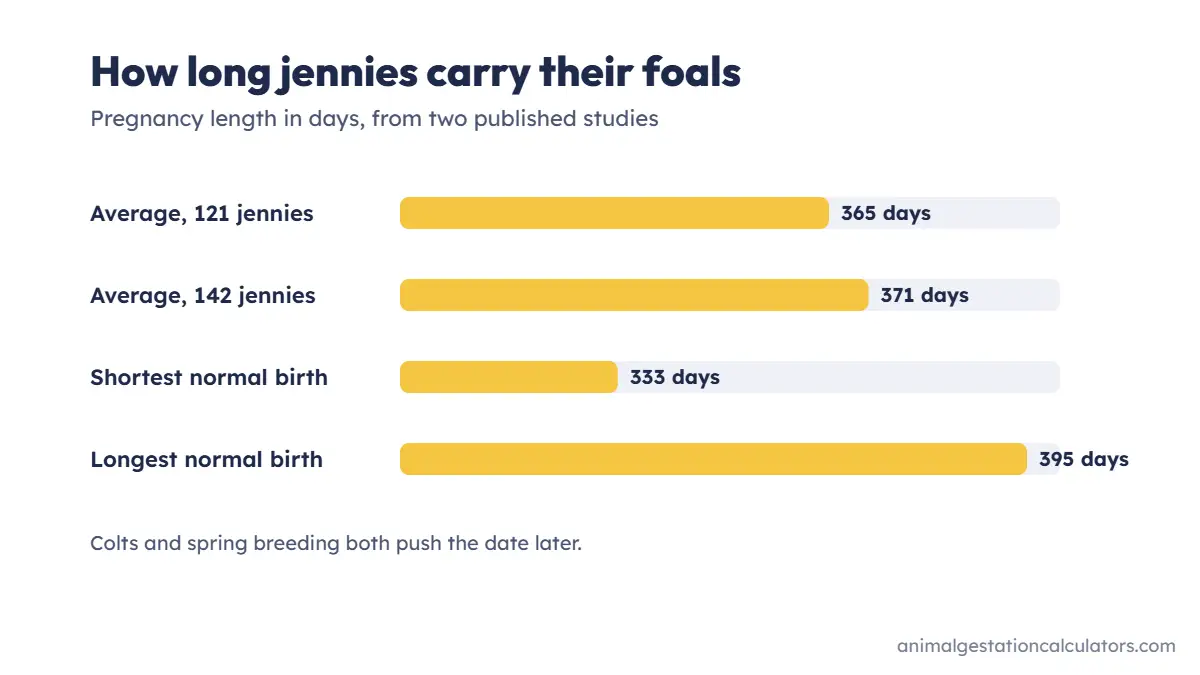
The normal range is wide. In two studies of healthy jennies, average pregnancies ran 365 and 371 days, and single births landed anywhere from day 333 to day 395.
| Days after breeding | Weeks | Months | What it means |
|---|---|---|---|
| 345 days | About 49 | About 11.3 | Start of the usual window |
| 365 days | About 52 | 12 | Average length |
| 385 days | 55 | About 12.7 | End of the usual window |
| 395 days | About 56 | About 13 | Longest seen in healthy jennies |
Why do some jennies carry longer than others?
Two things move the date in a measurable way: the sex of the foal and the season she was bred.
- Colts take longer. In a study of 121 jennies, those carrying colts went about four days longer than those carrying fillies. A second study of 142 Martina Franca jennies found the same pattern.
- Spring breeding means a longer wait. In the same 121-jenny study, jennies bred in spring carried about 16 days longer than those bred in summer or fall.
- Her age did not matter. Jennies aged 4 to 12 years carried for the same length of time.
So a spring-bred jenny carrying a colt may well go past day 380. That alone is not a problem if she is bright, eating and showing no discharge.
How does a donkey pregnancy compare with a horse?
Donkeys and horses are close cousins, but jennies carry longer and their foals are smaller.
| Donkey (jenny) | Horse (mare) | |
|---|---|---|
| Average pregnancy | About 365 days (12 months) | About 340 days (11 months) |
| Usual window | 345–385 days | 320–370 days |
| Heat cycle | About 23 days | About 21 days |
| Foals per pregnancy | Almost always one | Almost always one |
For mares, use our horse gestation calculator, since a mare’s window is shorter. Alpacas and llamas fall between the two at about 11.5 months.
How long is a mule pregnancy?
A mule comes from a donkey father and a horse mother. A hinny is the reverse: a horse father and a donkey mother.
The mother carries the foal, so plan around her species. A mare carrying a mule foal mostly follows horse timing, though some go a little longer. A jenny carrying a hinny follows donkey timing. Watch from the start of the mother’s normal window and keep watching past her average date.
Are miniature and mammoth donkeys different?
All donkeys are the same species, so the same 12-month guide applies to miniature, standard and mammoth jennies. Size changes the foal’s birth weight far more than the length of the pregnancy.
Use the calculator the same way for every size. Then watch her, not the calendar, as the date gets close.
When is a jenny ready to breed?
A jenny comes into heat about every 23 days, a little longer than a mare in heat. Each heat lasts around 6 days, based on a study of mammoth jennies. Signs include “jawing” (opening and closing her mouth), raising her tail, squatting and urinating near the jack.
She usually comes back into heat within about two weeks of foaling. Conception is less reliable on that first heat, so many owners wait for the next one.
How can you tell if a donkey is pregnant?
Early on, there is little to see. A jenny who does not come back into heat about three weeks after breeding may be in foal, but some pregnant jennies still show heat and some open jennies stop cycling.
The reliable answer is a vet check. An ultrasound in the first few weeks can confirm the pregnancy and pick up twins, which is the most useful time to find them. Her belly usually stays small for months, so a round shape is a poor guide.
What are the signs a donkey is close to foaling?
Jennies give quiet signs, and many foal at night. Here is what to watch for in the last weeks:
- Weeks before: her udder fills and shrinks again, sometimes for up to four weeks.
- About 3 days before: the udder and teats swell fully and milk may start to run.
- 1 to 2 days before: wax-like drops form on the teats, and the muscles around her tail soften.
- Hours before: she wanders off alone, stops eating, gets restless and may roll.
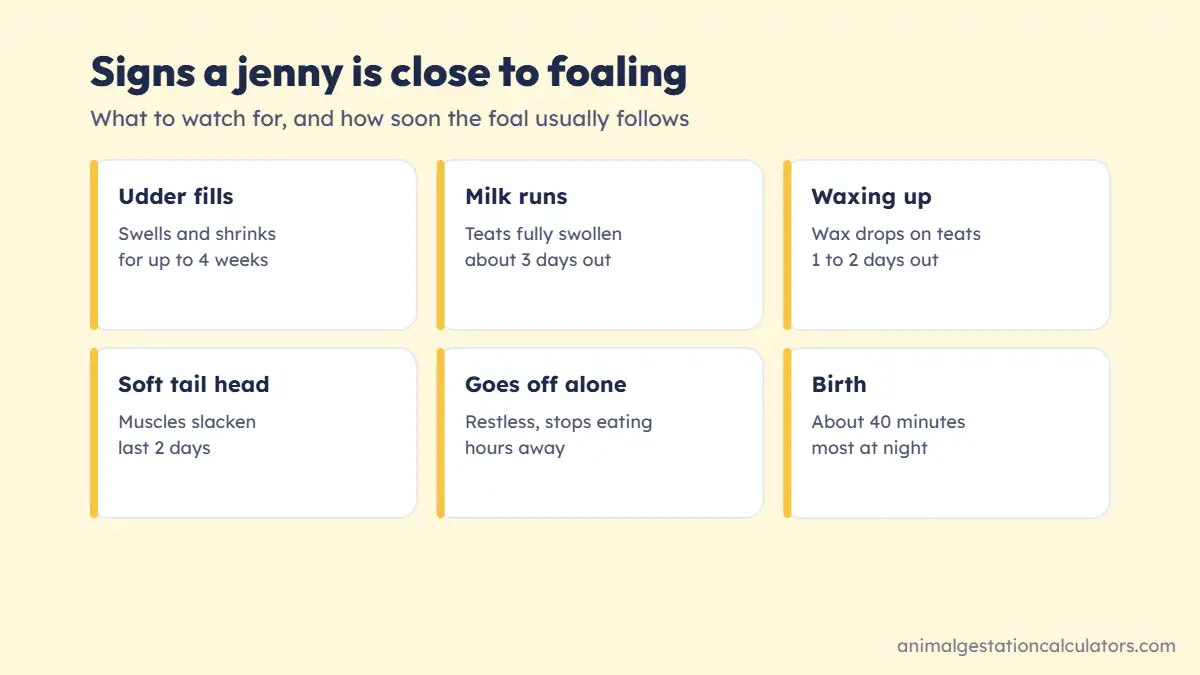
The birth itself is quick. It usually takes about 40 minutes from the first strong signs until the foal is out.
What should happen after the foal is born?
Check these milestones and call your vet if one is missed:
- The foal stands and tries to nurse within the first couple of hours.
- The foal drinks colostrum (first milk) within 2 to 4 hours of birth. This gives it the antibodies it needs.
- The jenny passes the afterbirth within about an hour. If there is no progress at two hours, call your vet.
- The foal’s gums turn bright pink and it breathes steadily.
Book a vet check for the next day, even if all went well.
Donkey foaling date table
Find the breeding date in the first column. The second column shows the 365-day average, and the third shows the usual window.
| Bred on | Foaling date | Normal window |
|---|---|---|
| Jan 1 | Jan 1 | Dec 12 – Jan 21 |
| Jan 15 | Jan 15 | Dec 26 – Feb 4 |
| Feb 1 | Feb 1 | Jan 12 – Feb 21 |
| Feb 15 | Feb 15 | Jan 26 – Mar 6 |
| Mar 1 | Feb 29 | Feb 9 – Mar 20 |
| Mar 15 | Mar 14 | Feb 23 – Apr 3 |
| Apr 1 | Mar 31 | Mar 11 – Apr 20 |
| Apr 15 | Apr 14 | Mar 25 – May 4 |
| May 1 | Apr 30 | Apr 10 – May 20 |
| May 15 | May 14 | Apr 24 – Jun 3 |
| Jun 1 | May 31 | May 11 – Jun 20 |
| Jun 15 | Jun 14 | May 25 – Jul 4 |
| Jul 1 | Jun 30 | Jun 10 – Jul 20 |
| Jul 15 | Jul 14 | Jun 24 – Aug 3 |
| Aug 1 | Jul 31 | Jul 11 – Aug 20 |
| Aug 15 | Aug 14 | Jul 25 – Sep 3 |
| Sep 1 | Aug 31 | Aug 11 – Sep 20 |
| Sep 15 | Sep 14 | Aug 25 – Oct 4 |
| Oct 1 | Sep 30 | Sep 10 – Oct 20 |
| Oct 15 | Oct 14 | Sep 24 – Nov 3 |
| Nov 1 | Oct 31 | Oct 11 – Nov 20 |
| Nov 15 | Nov 14 | Oct 25 – Dec 4 |
| Dec 1 | Nov 30 | Nov 10 – Dec 20 |
| Dec 15 | Dec 14 | Nov 24 – Jan 3 |
Frequently asked questions
How many months is a donkey pregnant?
About 12 months. Most jennies foal between 11 and 13 months after breeding. The average is 365 days.
How many babies does a donkey have at once?
Almost always one. Jennies can release two eggs, especially some mammoth jennies, but twin foals are rare and risky. That is why an early ultrasound to check for twins is worth booking.
Can a donkey be pregnant for 13 months?
Yes. Healthy jennies have foaled as late as day 395, which is about 13 months. If she is past day 385, ask your vet to check her, but do not try to hurry the birth.
Do donkeys usually foal at night?
Yes, most do. Check her late in the evening and early in the morning once wax shows on her teats.
At what age can a donkey get pregnant?
Young jennies can come into heat before they are fully grown. Most owners wait until she is mature in body before breeding. Ask your vet about her size and condition.
What animal has the longest pregnancy?
Among land animals, the elephant. Its pregnancy lasts about 660 days, almost two years. A donkey’s year-long pregnancy is one of the longest of any farm animal. A cow carries for about 283 days, for comparison.