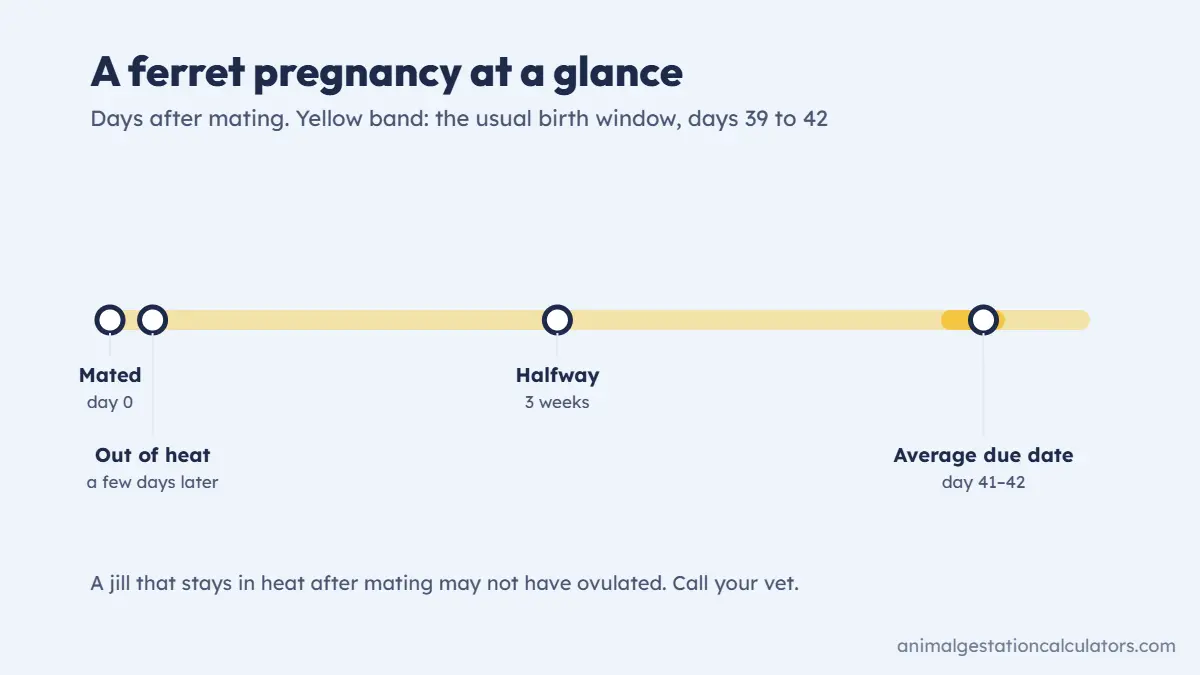
Quick answer: The ferret gestation period is about 41 to 42 days, or 6 weeks. Most kits are born between day 39 and day 42 after mating. Enter the mating date above to get the due date and the window to watch.
Ferret gestation period: how long are ferrets pregnant?
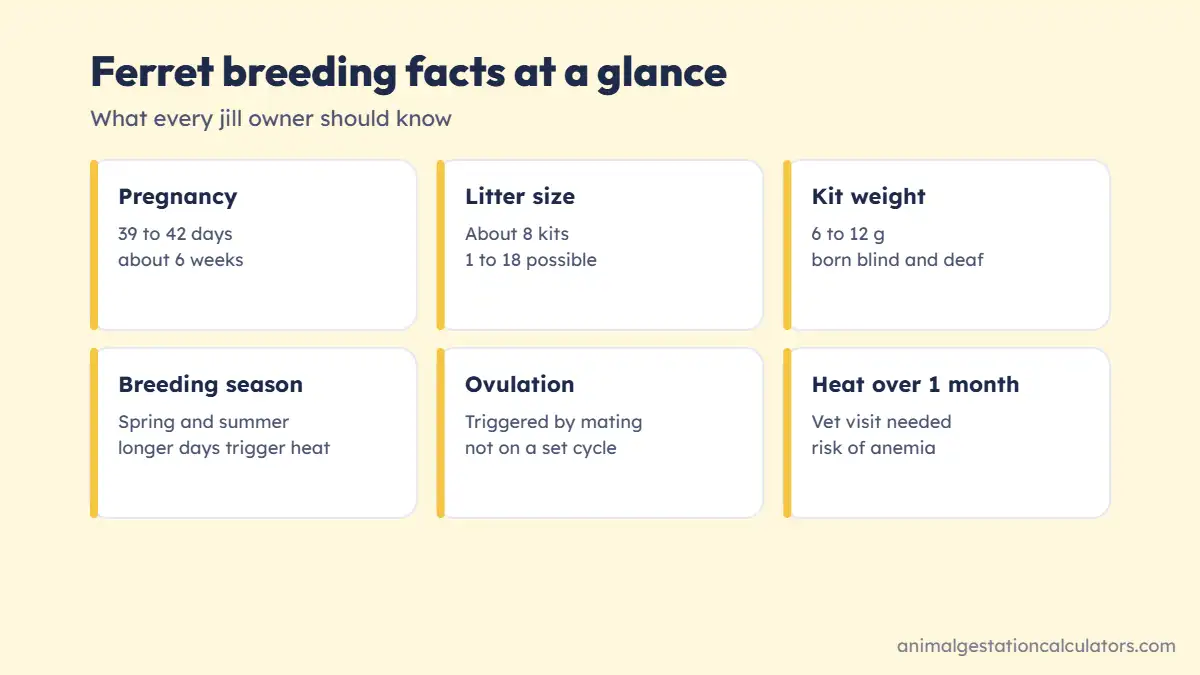
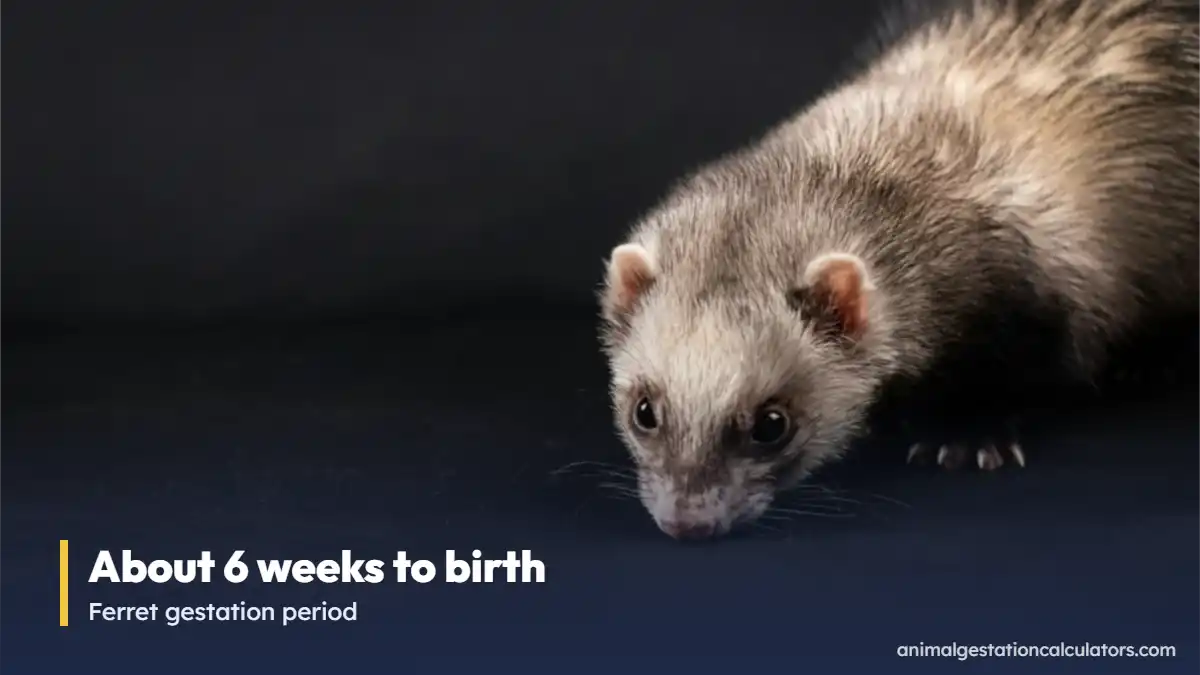
A female ferret, called a jill, is pregnant for about six weeks. The average is 41 to 42 days, and 39 to 42 days is the usual range.
| Days after mating | Weeks | What it means |
|---|---|---|
| 39 days | About 5.5 | Start of the usual window |
| 41–42 days | 6 | Average length |
| Past 42 days | Over 6 | Call your vet if no kits have arrived |
Why does mating date matter so much in ferrets?
Ferrets are induced ovulators. A jill only releases her eggs when she mates. So the mating date is also the start of the pregnancy, which makes the due date easy to work out.
It also explains the biggest health risk for unspayed jills. A jill who comes into heat and does not mate can stay in heat for weeks or months. That keeps her estrogen high, and high estrogen for a long time can shut down her bone marrow. The result is a severe anemia that can kill her.
If a jill is in heat for longer than about a month, see your vet. They can end the heat with a hormone injection, an implant or spaying.
When do ferrets breed?
Ferrets are seasonal breeders. Longer days bring them into heat, so in the Northern Hemisphere the season runs from about March to September. Jills usually reach maturity in their first spring, at 4 to 8 months old.
A jill in heat has a large, swollen vulva. The swelling grows over two to three weeks before she is ready to mate. It goes down within a few weeks after a successful mating.
How can you tell if a ferret is pregnant?
The first sign is that her vulva shrinks back to normal size after mating. If it stays swollen, she may not have ovulated, and she needs a vet check.
Later signs are easier to spot:
- Her belly fills out from about week 3 or 4.
- She gains weight steadily. Weigh her weekly to track it.
- She starts building a nest in the last week.
A vet can confirm the pregnancy by feeling her belly or with an ultrasound. This matters because ferrets also have false pregnancies.
What is a false pregnancy in ferrets?
If a jill mates with a neutered male, or the mating does not produce kits, she can still ovulate. Her body then acts pregnant for about 42 days. She may gain weight, build a nest and even make milk, yet no kits arrive.
This is normal, and the heat ends as it would after a real pregnancy. Some owners use a vasectomized male on purpose to end a jill’s heat without breeding her. Ask your vet if that suits your ferret.
How many babies do ferrets have?
A typical litter is about 8 kits, but anywhere from 1 to 18 is possible. Kits weigh only 6 to 12 grams (about 0.2 to 0.4 ounces) at birth. They are born pink, with closed eyes and ears, much like hamster pups.
Very small litters can be a problem. A jill carrying only one or two kits may not go into labor on time, and the kits can grow too large to deliver. If she passes day 42 with no kits, call your vet the same day.
Preparing for the birth
- Give her a quiet nest box with soft bedding about a week before her due date.
- Keep other ferrets, including the father, away from her and the kits.
- Feed a high-quality ferret food and keep fresh water within easy reach.
- Avoid handling her a lot in the last days and the first week after birth.
Caring for ferret kits
Kits nurse for the first few weeks and begin eating soft solid food at around 3 weeks old. Their eyes open at around 4 to 5 weeks. They are weaned by 6 to 8 weeks, and that is the earliest they should go to new homes.
Weigh the kits every few days. A kit that stops gaining needs a vet check.
Ferret due date table
Pick the day she mated in the first column. Next to it is her likely due date at 41 days, then the full 39- to 42-day window.
| Bred on | Due date | Normal window |
|---|---|---|
| Jan 1 | Feb 11 | Feb 9 – Feb 12 |
| Jan 15 | Feb 25 | Feb 23 – Feb 26 |
| Feb 1 | Mar 14 | Mar 12 – Mar 15 |
| Feb 15 | Mar 28 | Mar 26 – Mar 29 |
| Mar 1 | Apr 11 | Apr 9 – Apr 12 |
| Mar 15 | Apr 25 | Apr 23 – Apr 26 |
| Apr 1 | May 12 | May 10 – May 13 |
| Apr 15 | May 26 | May 24 – May 27 |
| May 1 | Jun 11 | Jun 9 – Jun 12 |
| May 15 | Jun 25 | Jun 23 – Jun 26 |
| Jun 1 | Jul 12 | Jul 10 – Jul 13 |
| Jun 15 | Jul 26 | Jul 24 – Jul 27 |
| Jul 1 | Aug 11 | Aug 9 – Aug 12 |
| Jul 15 | Aug 25 | Aug 23 – Aug 26 |
| Aug 1 | Sep 11 | Sep 9 – Sep 12 |
| Aug 15 | Sep 25 | Sep 23 – Sep 26 |
| Sep 1 | Oct 12 | Oct 10 – Oct 13 |
| Sep 15 | Oct 26 | Oct 24 – Oct 27 |
| Oct 1 | Nov 11 | Nov 9 – Nov 12 |
| Oct 15 | Nov 25 | Nov 23 – Nov 26 |
| Nov 1 | Dec 12 | Dec 10 – Dec 13 |
| Nov 15 | Dec 26 | Dec 24 – Dec 27 |
| Dec 1 | Jan 11 | Jan 9 – Jan 12 |
| Dec 15 | Jan 25 | Jan 23 – Jan 26 |
Frequently asked questions
How many weeks is a ferret pregnant?
About 6 weeks. The average is 41 to 42 days from the mating.
What happens to female ferrets if they don’t mate?
Many stay in heat for a long time. Months of high estrogen can damage the bone marrow and cause a life-threatening anemia. Spaying or a vet-given hormone treatment prevents this.
Can a spayed ferret get pregnant?
No. A properly spayed jill has no ovaries or uterus. If a spayed ferret shows a swollen vulva, see your vet, because it can point to leftover ovary tissue or an adrenal problem.
At what age can a ferret get pregnant?
Usually in her first spring, at 4 to 8 months old. Ask your vet whether she is big and healthy enough first.
Do ferrets eat their babies?
It can happen, mostly when the mother is stressed, disturbed or short of food. A quiet nest and good feeding lower the risk.
How does a ferret pregnancy compare with a dog or cat?
It is about three weeks shorter. A dog carries for about 63 days, as our guide to how long dogs are pregnant explains, and a cat carries for about 65 days.