Quick answer: The chinchilla gestation period is about 111 days, or just under 4 months. Most kits are born between day 105 and day 118 after mating. Enter the mating date above to get the due date and the window to watch.
Chinchilla gestation period: how long are chinchillas pregnant?
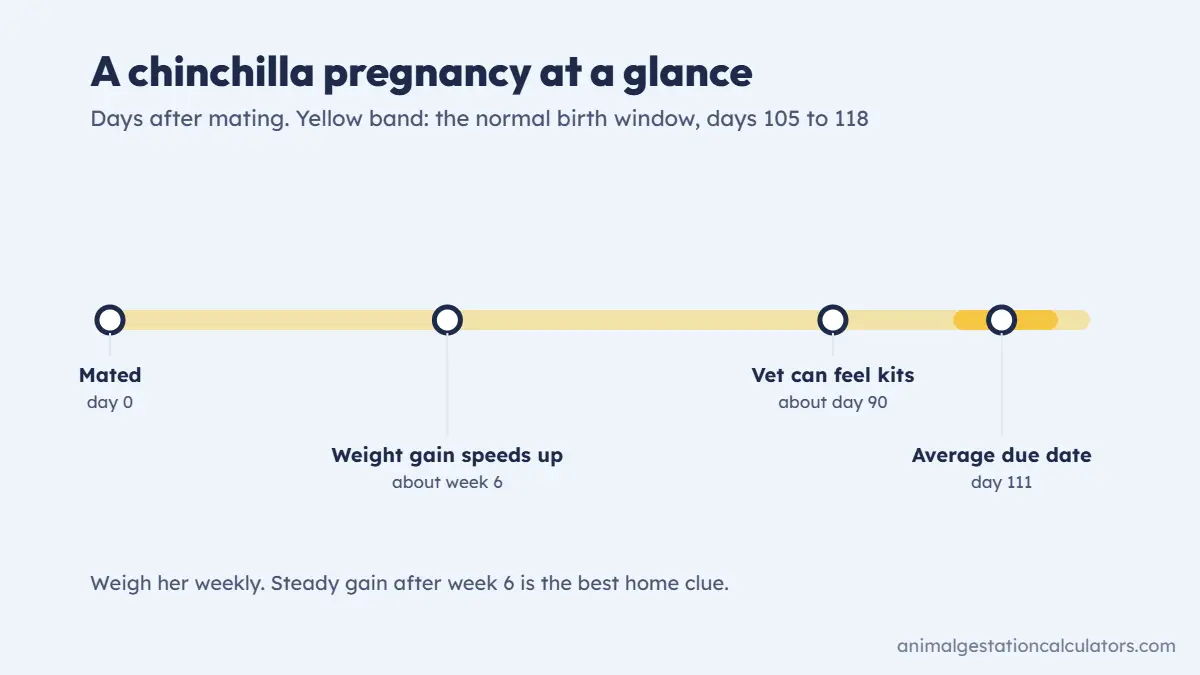
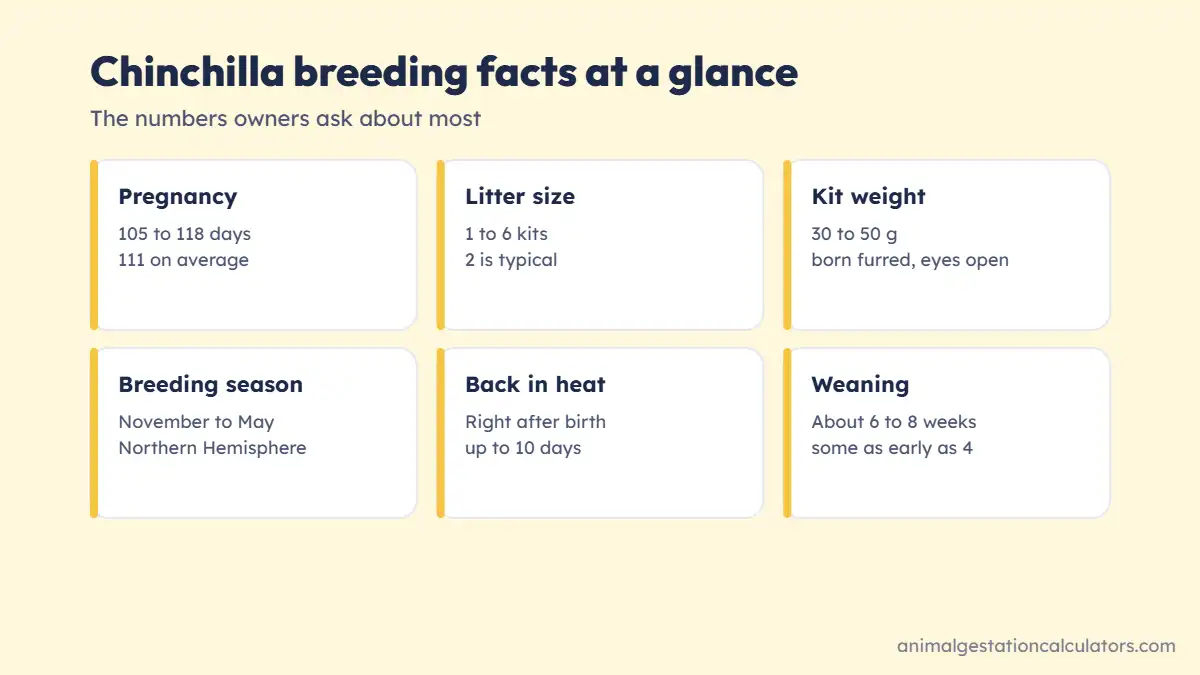
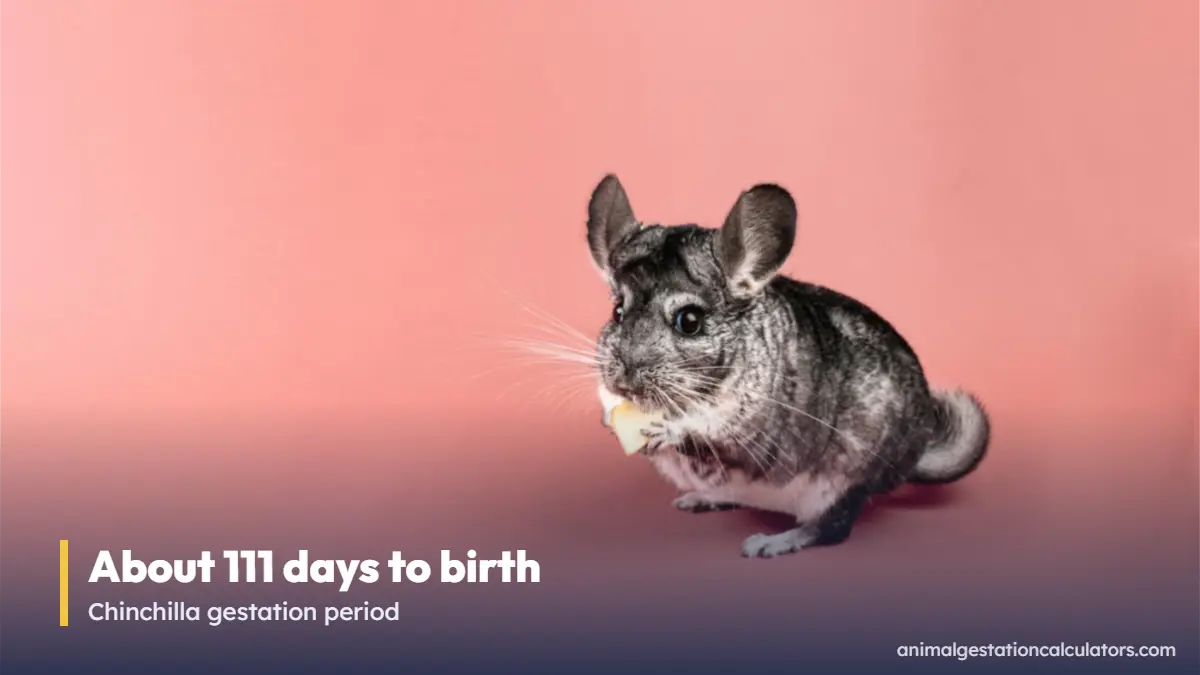
A chinchilla is pregnant for about 111 days, with 105 to 118 days counted as normal. That is very long for a small rodent. A hamster carries for only about 16 days.
| Days after mating | Weeks | Months | What it means |
|---|---|---|---|
| 105 days | 15 | About 3.5 | Start of the normal window |
| 111 days | About 16 | About 3.7 | Average length |
| 118 days | About 17 | About 3.9 | End of the normal window |
The long wait pays off. Kits are born with a full coat, open eyes and teeth, and they move around within an hour or so.
When do chinchillas breed?
In the Northern Hemisphere, chinchillas breed mainly from November to May. During that season, a female comes into heat about every 28 to 35 days, though cycles of 15 to 90 days are reported. Each heat lasts about 4 to 5 days.
Females can mature at 4 to 6 months, but they are not ready to breed that young. Most breeders wait until she is 8 to 12 months old and weighs at least 600 grams (about 21 ounces).
How can you tell if a chinchilla is pregnant?
Chinchillas hide pregnancy well. A thick coat and small litters mean her belly may barely change. These checks work best:
- Weigh her weekly. Her weight gain speeds up from about week 6. A digital kitchen scale is fine.
- Watch her appetite. She may eat more as the weeks pass.
- Ask your vet. From about day 90, a vet can usually feel the kits. An X-ray late in pregnancy shows how many to expect.
Keep a written log of the mating date and her weekly weights. It makes the due date far easier to trust.
How many babies do chinchillas have?
A litter has 1 to 6 kits, and 2 is most common. Each kit weighs about 30 to 50 grams (1 to 1.8 ounces) at birth. Females usually have up to two litters a year. A ferret litter is far bigger, at about 8 kits.
What happens when a chinchilla gives birth?
Most births go smoothly and happen early in the morning. Have the cage ready before day 105:
- Remove upper shelves and ramps, so newborn kits cannot fall.
- Take away the dust bath for a few days after the birth, so dust does not get into her birth canal.
- Give her a quiet, draft-free spot and plenty of fresh hay.
Problems are uncommon, but they do happen. They are usually caused by one very large kit or a kit lying the wrong way. Call your vet at once if she strains for more than about an hour without a kit, bleeds heavily, or seems weak afterward.
Why you should move the male before the birth
A female comes back into heat right after giving birth and can stay receptive for up to 10 days. If the male is with her, she can become pregnant again straight away.
Back-to-back pregnancies drain her, especially while she is nursing. Move the male to his own cage before her due date, and keep them apart until the kits are weaned.
Caring for chinchilla kits
Kits nurse from their mother but start nibbling hay and pellets within days. Weigh them every day or two. A kit that is not gaining may not be getting enough milk and may need hand-feeding with your vet’s help.
Kits are usually weaned between 6 and 8 weeks old. Separate males from their mother and sisters once they are weaned.
Chinchilla due date table
Look up the day she was mated on the left. The middle column is her likely due date at 111 days, and the right column is the full 105- to 118-day window.
| Bred on | Due date | Normal window |
|---|---|---|
| Jan 1 | Apr 22 | Apr 16 – Apr 29 |
| Jan 15 | May 6 | Apr 30 – May 13 |
| Feb 1 | May 23 | May 17 – May 30 |
| Feb 15 | Jun 6 | May 31 – Jun 13 |
| Mar 1 | Jun 20 | Jun 14 – Jun 27 |
| Mar 15 | Jul 4 | Jun 28 – Jul 11 |
| Apr 1 | Jul 21 | Jul 15 – Jul 28 |
| Apr 15 | Aug 4 | Jul 29 – Aug 11 |
| May 1 | Aug 20 | Aug 14 – Aug 27 |
| May 15 | Sep 3 | Aug 28 – Sep 10 |
| Jun 1 | Sep 20 | Sep 14 – Sep 27 |
| Jun 15 | Oct 4 | Sep 28 – Oct 11 |
| Jul 1 | Oct 20 | Oct 14 – Oct 27 |
| Jul 15 | Nov 3 | Oct 28 – Nov 10 |
| Aug 1 | Nov 20 | Nov 14 – Nov 27 |
| Aug 15 | Dec 4 | Nov 28 – Dec 11 |
| Sep 1 | Dec 21 | Dec 15 – Dec 28 |
| Sep 15 | Jan 4 | Dec 29 – Jan 11 |
| Oct 1 | Jan 20 | Jan 14 – Jan 27 |
| Oct 15 | Feb 3 | Jan 28 – Feb 10 |
| Nov 1 | Feb 20 | Feb 14 – Feb 27 |
| Nov 15 | Mar 5 | Feb 28 – Mar 12 |
| Dec 1 | Mar 21 | Mar 15 – Mar 28 |
| Dec 15 | Apr 4 | Mar 29 – Apr 11 |
Frequently asked questions
How many months is a chinchilla pregnant?
About 3.7 months, or just under 4 months. The average is 111 days.
How often do chinchillas get pregnant?
Usually up to twice a year. She can conceive again right after giving birth, so moving the male out is the only way to give her a rest.
Do chinchilla babies need a heat lamp?
No. Kits are born with a full coat, and chinchillas overheat easily. Keep the room cool, ideally below about 75°F (24°C), and away from direct sun.
Can a chinchilla be pregnant without looking pregnant?
Yes, very often. A small litter under a thick coat can be almost invisible. Weekly weighing is the most reliable way to notice.
Is the long-tailed chinchilla pregnant for the same time?
Yes. Almost all pet chinchillas are the long-tailed kind, which carries for about 111 days. The rare short-tailed chinchilla carries longer, at about 128 days.
How does a chinchilla pregnancy compare with a guinea pig?
It is about six weeks longer. A guinea pig is pregnant for about 68 days. Both have well-developed young that are born furred and alert.