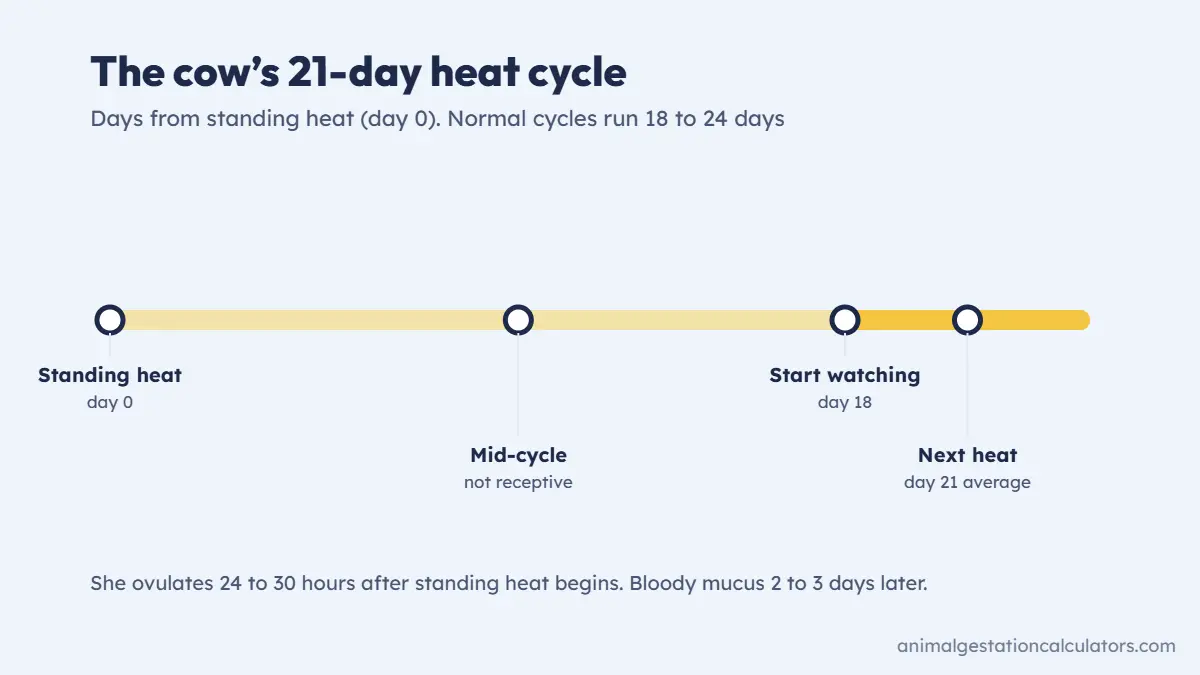
Quick answer: The cow heat cycle lasts about 21 days, and anything from 18 to 24 days is normal. Standing heat, when she lets others mount her, usually lasts 12 to 18 hours, though it can be much shorter or longer. She ovulates about 24 to 30 hours after heat begins. Enter the first day of her last heat below to see when the next ones are due.
Tip: if you have dates from her past heats, pick her own gap.
Next heat expected
Pick a date
Heat usually lasts 4 to 30 hours (often 12 to 18).
Watch early morning and evening for at least 20 to 30 minutes.
How does the cow heat cycle work?
The estrous cycle of a cow repeats about every 21 days until she becomes pregnant. A cow in heat is in the short fertile part of that cycle.
| Day of cycle | What happens |
|---|---|
| Day 0 | Standing heat. She stands still to be mounted. |
| Day 1 | She ovulates, about 24 to 30 hours after heat began. |
| Days 2–3 | Some cows pass bloody mucus. This shows heat has passed, not that she conceived. |
| About day 5 | A corpus luteum forms on the ovary and makes progesterone. |
| About day 17 | If she is not pregnant, the uterus releases a hormone that breaks down the corpus luteum. |
| About day 21 | She comes back into heat. |
If she does not come back into heat about three weeks after breeding, she may be pregnant. A vet check confirms it.
How long is a cow in heat?
Standing heat usually lasts 12 to 18 hours. It can range from about 4 to 30 hours. Heifers and cows in hot weather often have shorter heats, which makes them easier to miss.
The signs around standing heat last longer. A cow may act restless for a day or two before, and she may show mucus for a while after.
What are the signs of a cow in heat?
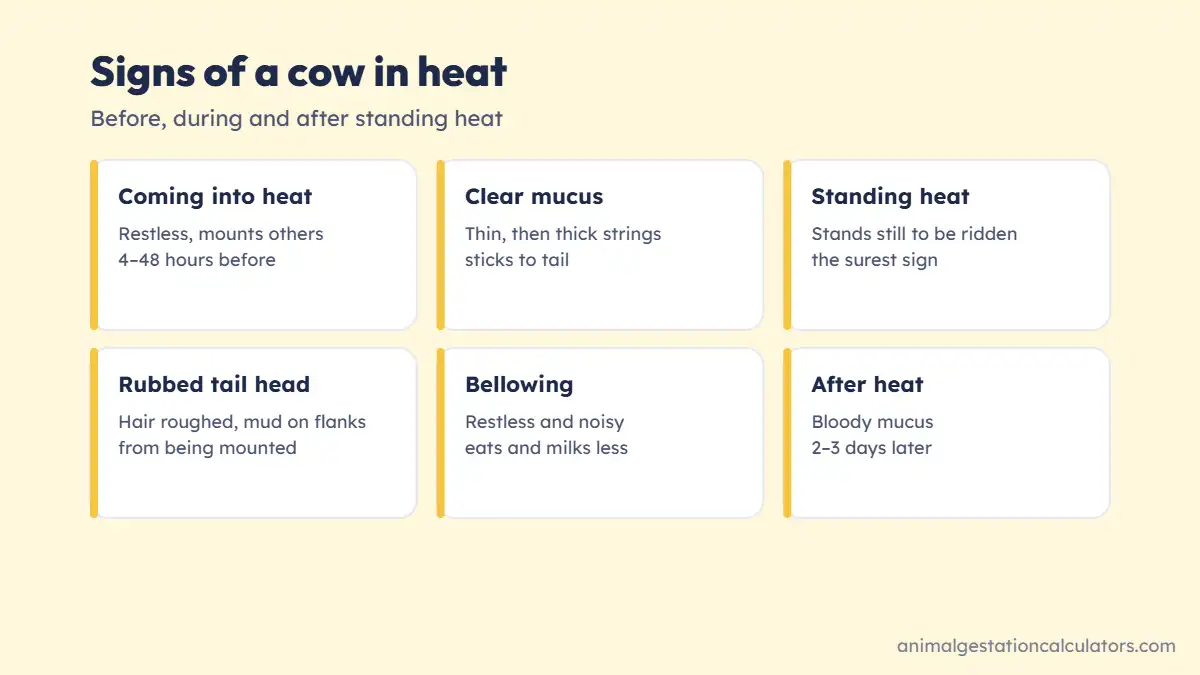
The only sure sign is standing to be ridden. A cow that stands firm while another cow or bull mounts her is in standing heat. The other signs tell you which cows to watch closely:
- Before standing heat (4 to 48 hours): restlessness, mounting other cows, following others around, and a little clear mucus.
- During standing heat: standing to be mounted, thick and clear strings of mucus, a red and swollen vulva, bellowing, peeing often, and less milk or appetite.
- After heat: roughed-up hair and dirt on the tail head and hips from being ridden, then bloody mucus 2 to 3 days later.
Heifers often hold their tail raised when in heat. That can be a useful clue in a group of young stock.
How to check cattle for heat
Heat detection is mostly about timing and patience. These habits catch more heats:
- Watch early morning and evening. Cows are most active then, and many heats start overnight.
- Spend real time. Give each check at least 20 to 30 minutes, and longer if you are unsure.
- Watch, do not work. Cows show heat less while being fed, milked or moved.
- Use aids. Tail chalk, tail paint or heat-mount patches show who has been ridden. Activity monitors help in bigger herds.
- Keep records. Write down every heat. A date sheet lets you plan the next check, as the calculator above does.
In a herd where every cow is cycling, about 1 in 20 should show heat on any given day. If you see far fewer, either cows are not cycling or heats are being missed.
When should you breed a cow after heat?
Many farms use the AM-PM rule. It works because she ovulates about a day after heat starts:
- A cow first seen in heat in the morning is bred that afternoon or evening.
- A cow first seen in heat in the afternoon is bred the next morning.
The goal is to breed about 12 hours after heat begins. Once she is bred, the cow gestation calculator gives you the calving date.
When do heifers and cows start cycling?
Heifers usually reach puberty at about 11 months old. To calve at two years, a heifer needs to be cycling by about 14 to 15 months so she can be bred on time. Good growth and body condition matter more than age alone.
After calving, a cow usually has at least 40 days with no heat. Her first ovulation after calving is often “silent,” with no outward signs, and that first cycle tends to be short.
Why is my cow not coming into heat?
The most common reasons are:
- She is pregnant. Ask your vet to check before giving any hormone.
- She calved recently and has not started cycling again.
- She is too thin, or her diet is short on energy.
- She had a silent heat that nobody saw.
- She has a problem such as an ovarian cyst or a uterine infection.
If a cow has gone more than a few weeks past when you expected a heat, a vet exam is the fastest way to find out why.
Frequently asked questions
How many times does a cow go in heat?
About every 21 days, all year round, until she becomes pregnant. Unlike goats in heat or a mare in heat, cattle have no breeding season.
How many hours after heat will a cow ovulate?
About 24 to 30 hours after standing heat begins, or about 10 to 14 hours after it ends.
Does bleeding mean a cow is pregnant?
No. Bloody mucus 2 to 3 days after heat is normal whether she conceived or not. It tells you she was in heat, but it is too late to breed on that heat.
Can a pregnant cow show heat?
Sometimes. A small share of pregnant cows show heat signs. Check with your vet before breeding a cow that may already be pregnant.
What is a silent heat in cattle?
A heat where she ovulates but shows few or no signs. It is common for the first ovulation after calving and can happen at other times too.
Do heifers show heat differently from cows?
Heifers often have shorter heats and tend to raise their tails. Watch them at least as closely as the older cows.