Quick answer: A cat about to give birth usually stops eating, hunts for a quiet nest, and becomes restless or vocal. Her temperature may drop below 100°F. Once she starts pushing, each kitten arrives in 5 to 30 minutes, and most cats deliver the whole litter within 6 hours.
What are the signs a cat is going into labor?
In the last week, most cats start looking for a hidden, quiet spot to nest. In the final day, she will often stop eating and act restless. Her rectal temperature may drop below 100°F. These signs mean kittens are likely within 24 hours.
- Nesting: searching closets, boxes or under beds in the last week.
- Off her food: she often stops eating in the last 24 hours.
- Restless: pacing, getting in and out of the nest, or following you around.
- Vocal or purring: many cats meow, call or purr loudly.
- Licking: grooming her belly and genitals more than usual.
- Panting: fast breathing as contractions begin.
If you have the mating date, the cat pregnancy calculator shows when to start watching for these signs. If you are not yet sure she is pregnant, start with how to tell if a cat is pregnant.
How long is a cat in labor?
Most cats deliver all their kittens within 6 hours of the first one. Early labor is often short too. In a study of over 1,000 pedigree litters, early labor lasted under 2 hours in 83 percent of births. A first-time mother can stay in early labor for up to 36 hours.
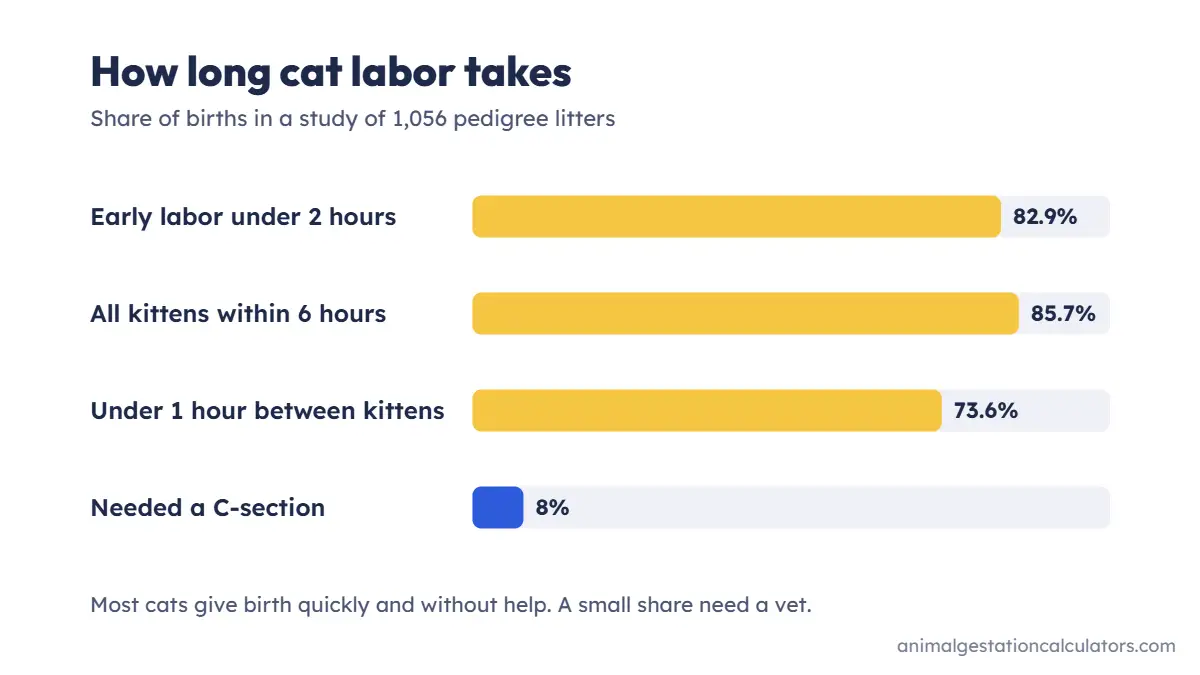
Long pauses can be normal. Most kittens arrive 10 minutes to 1 hour apart, but some cats rest for 24 to 36 hours partway through. She will be calm, nurse the first kittens and eat during the break. A pause with straining is different and needs a vet.
What happens in each stage of cat labor?
Cat labor has three stages. In stage 1 the cervix opens and she gets restless. In stage 2 she pushes out a kitten. In stage 3 the placenta passes. Stages 2 and 3 repeat for each kitten.
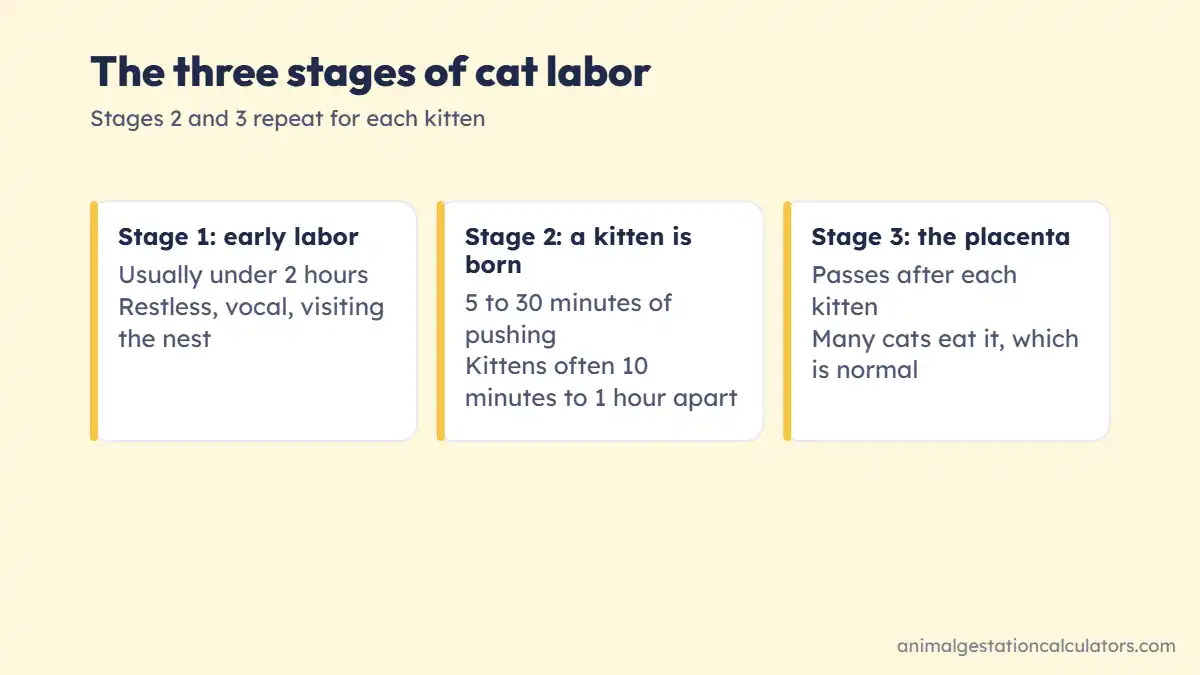
Stage 1: early labor
She paces, pants, purrs or calls out, and may visit the nest over and over. You may not see any pushing. Let her settle in her box and keep the room quiet.
Stage 2: the kittens are born
Strong contractions start and she pushes. Each kitten usually arrives 5 to 30 minutes after pushing begins, often still inside its sac. She will lick the sac off, clean the kitten and chew through the cord.
Stage 3: the placenta
The placenta, or afterbirth, usually follows each kitten. Many cats eat it, which is normal. Count the placentas if you can, and tell your vet if there are fewer than kittens.
What should you do when your cat is giving birth?
Mostly, stay calm and stay out of the way. Most cats give birth without help. Keep the room warm and quiet, keep other pets away, and watch from a short distance. Write down the time each kitten arrives so you can spot a long gap.
- Set up a nesting box with clean towels a week or two before the due date.
- Keep your vet’s number and an emergency clinic’s number handy.
- Don’t pull on a kitten or the cord unless your vet tells you to.
- If she doesn’t open a sac within a minute or so, gently tear it open near the kitten’s face and wipe its nose.
When should you call the vet?
Call your vet if she has strong contractions for 20 minutes without a kitten, or if a kitten is visible but not born after 10 minutes. Fresh red bleeding that lasts more than 10 minutes, or a temperature above 103°F, also needs help right away.
In the pedigree study, 8 percent of litters needed a C-section, so there is no shame in calling early. VCA explains the warning signs in its guide to pregnancy and labor in cats.
How can you tell if there are more kittens inside?
The only sure way is to know how many to expect from an X-ray taken late in pregnancy. Without one, signs she is done include steady breathing, no more pushing, and settling down to nurse. If she still strains, seems unsettled or you are unsure, call your vet. Our guide to how many kittens a cat can have covers how that count works.
What does a cat do right after giving birth?
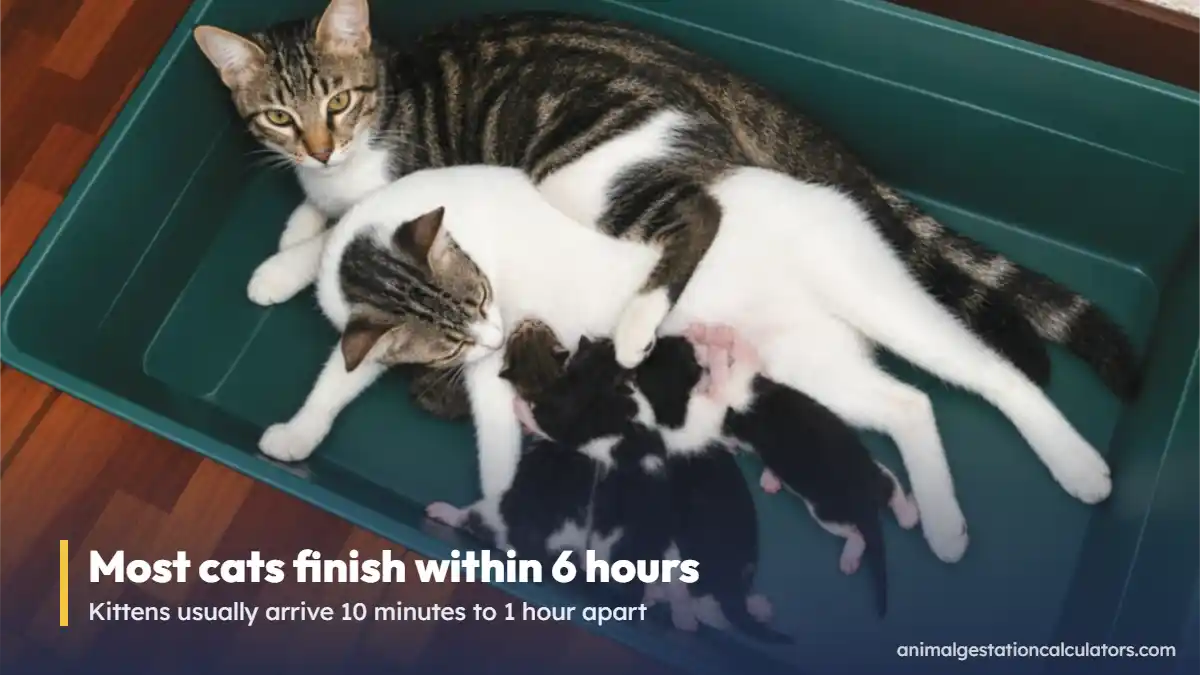
She cleans each kitten, eats the placentas, and lies down so the kittens can nurse. Most mothers stay in the nest for most of the first days. Keep the box at 85 to 90°F for the first 4 days, because newborn kittens can’t keep themselves warm.
Book a vet check for her and the kittens in the first few days. If she was not spayed, remember she can go back into heat soon, as explained in our cat heat cycle guide.
Frequently asked questions
Can a cat stop labor and start again the next day?
Yes. Some cats rest for 24 to 36 hours between kittens. During a normal pause she is calm, nurses and may eat. Straining during the pause is not normal, so call your vet.
Should I help my cat give birth?
Usually not. Most cats manage alone. Help only if she ignores a kitten’s sac, and call your vet for any long straining or a stuck kitten.
Is it normal for a cat to eat the placenta?
Yes. Most cats eat the afterbirth. It is normal and gives her nutrients. Just try to count them so you know none were left inside.
How warm should newborn kittens be kept?
Keep the nesting box at about 85 to 90°F for the first 4 days. You can then lower it slowly. A heating pad under part of the box gives the kittens a cooler spot too.
How often do cats need a C-section?
Not often. In a large study of pedigree cats, about 8 in every 100 litters needed one. Still, have a vet you can reach on the day.
Where will my cat want to give birth?
Somewhere dark, quiet and hidden, like a closet. Offer a box with towels in a calm room a week or two early. If she picks another spot, it is usually fine to let her.