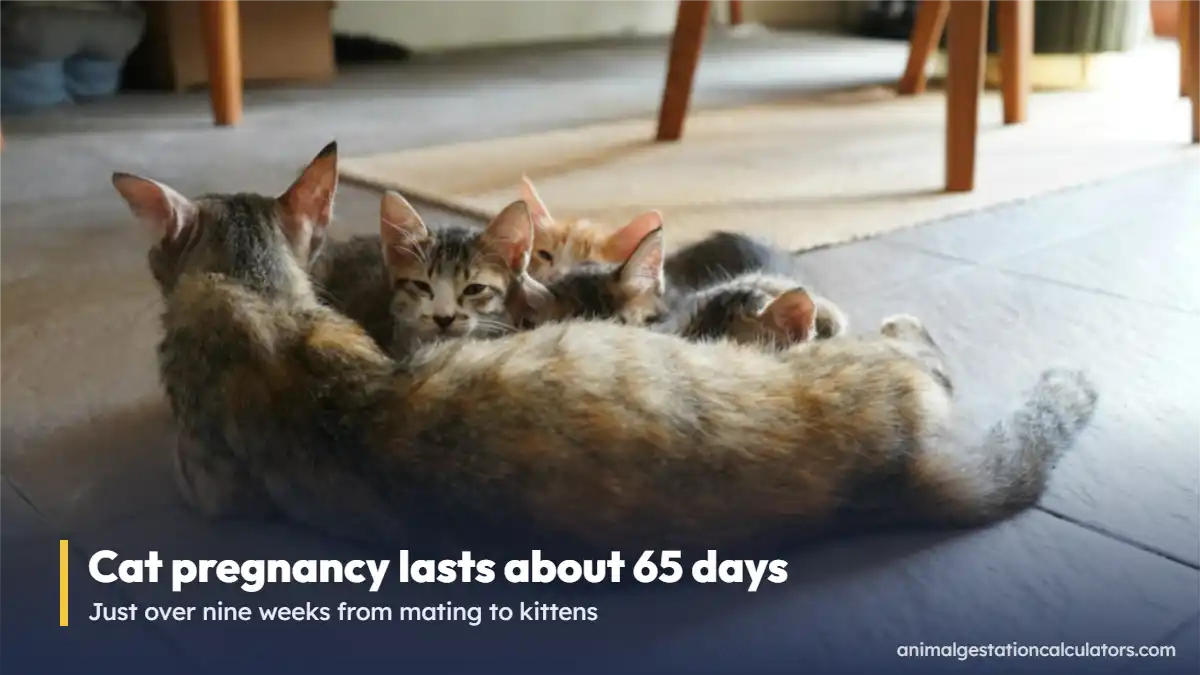
Quick answer: A cat pregnancy lasts about 65 days, or just over nine weeks. Her nipples turn pink and swell around week 3, her belly shows from about week 5, and she starts nesting in the last week. Most cats give birth to 4 or 5 kittens without any help.
What should you expect over the nine weeks?
A cat pregnancy runs about 65 days, and most cats give birth 64 to 66 days after mating. Cats can get pregnant from about 4 months old, and they ovulate when they mate, so one heat can easily lead to kittens. Our guide to how long cats are pregnant has a calculator for her due date.
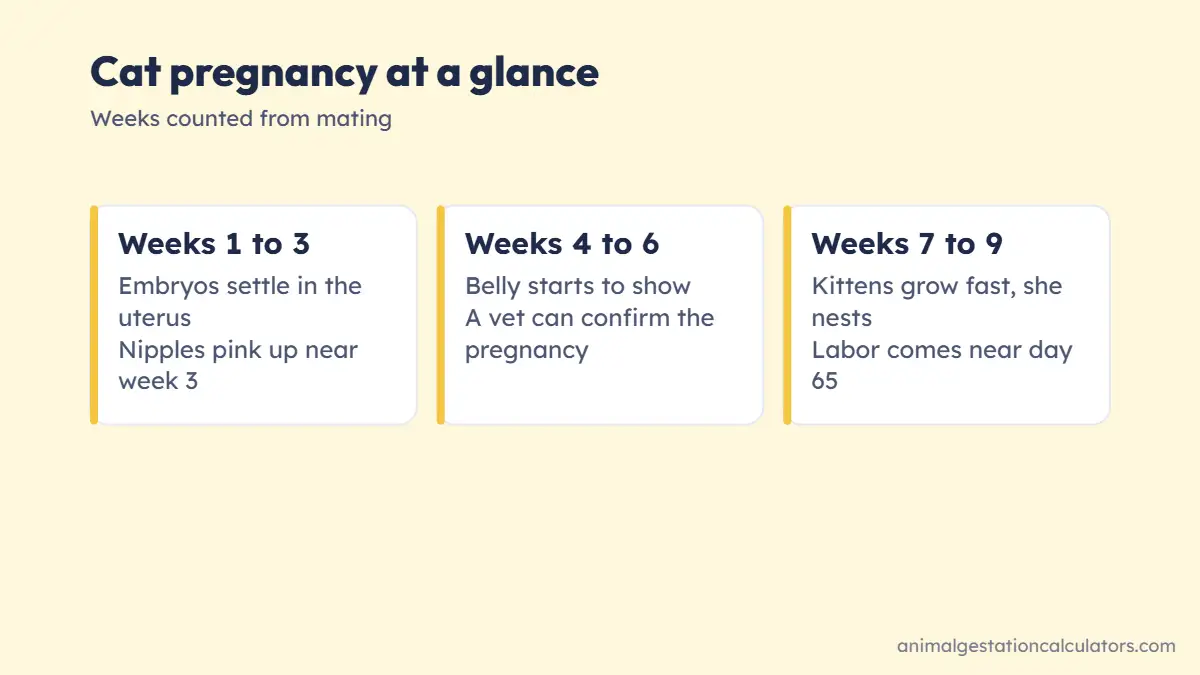
The pregnancy falls into three phases of about three weeks each. Little shows in the first phase. Her belly and appetite grow in the second. In the third she gains quickly and prepares a nest.
What are the early clues she is expecting?
The first clear sign is “pinking up,” when her nipples turn pink and larger at about 2 to 3 weeks. She may also be more affectionate, sleep more and eat more. Her belly usually rounds out from about week 5. See how to tell if a cat is pregnant for every early clue, including those in strays.
A vet can often feel the kittens at about 3 weeks, see heartbeats on ultrasound at 3 to 4 weeks, and see skeletons on an X-ray from about 6 weeks, with the best count after day 55. If she is a stray or you missed the mating, a vet check also tells you roughly how far along she is.
What happens in each stage of cat pregnancy?
During the first three weeks, fertilized eggs move down and implant in her uterus. From week 4 to week 6 the kittens’ organs form and grow, and her belly starts to show. In weeks 7 to 9 the kittens grow fast, she looks for a nest, and labor begins near day 65.
| Weeks | Her body and the kittens | Your job |
|---|---|---|
| 1 to 3 | Embryos settle, nipples pink up | Change nothing, skip unneeded medicines |
| 4 to 6 | Belly grows, appetite rises | Vet check, switch to kitten food |
| 7 to 9 | Fast growth, nesting | Set up a nesting box, keep her indoors |
What does a pregnant cat need from you?
Switch her to a kitten or growth food by the end of the first month and keep her on it until the kittens are weaned. Offer small, frequent meals late in pregnancy, when the kittens crowd her stomach. Keep fresh water close by.
- Vaccines: never give live vaccines during pregnancy. Ideally she is vaccinated before mating.
- Worms and fleas: take a stool sample to your vet, since some worms pass to kittens. Use only pregnancy-safe products your vet chooses.
- Indoors: keep her inside in the last weeks so she doesn’t give birth somewhere you can’t reach.
- Warning signs: call your vet if she stops eating, vomits, has diarrhea or has any bloody discharge.
The International Cat Care guide to cat pregnancy is a good read on feeding and birth.
How should you prepare for the kittens?
About one to two weeks before her due date, put a nesting box somewhere calm and draft-free. A cardboard box lined with old towels works well. Avoid loose threads that kittens could get tangled in. Let her explore it, but don’t force her to use it.
When labor starts, most cats need no help at all. Our cat labor signs guide shows what each stage looks like and when to call your vet. To know how many kittens to expect, read how many kittens a cat can have.
How do you care for the kittens after birth?
Newborn kittens weigh about 100 grams. They should double that in a week and triple it by three weeks. They rely fully on their mother for the first two to three weeks, start weaning at about four weeks and are ready for new homes at about eight weeks.
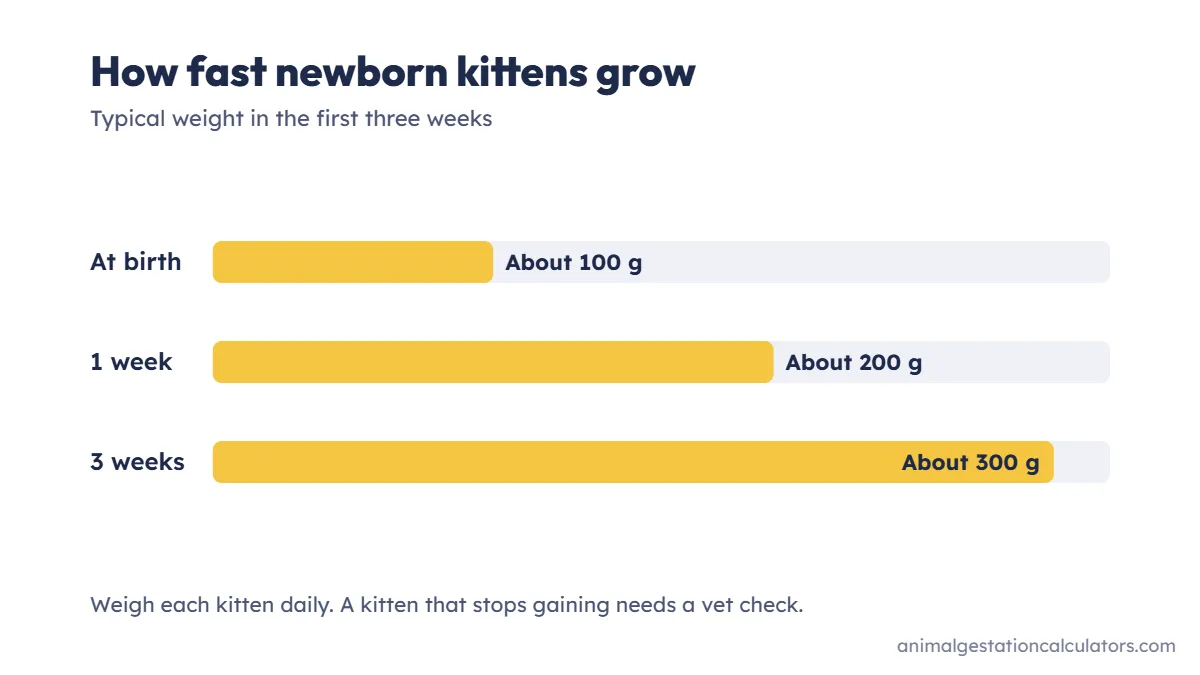
Keep the nest warm, weigh each kitten every day and watch that all of them nurse. A kitten that cries a lot, feels cold or stops gaining weight needs a vet the same day.
When can a cat get pregnant again?
Very soon. A cat can come back into heat within weeks of giving birth, even while nursing. Our cat heat cycle guide explains the timing. Spaying is the only sure way to prevent the next litter, and many vets spay a few weeks after the kittens are weaned.
Every cat pregnancy guide on this site
| Page | Read it when you want to |
|---|---|
| How long are cats pregnant | Find her due date with the calculator |
| How to tell if a cat is pregnant | Spot the signs at home |
| How many kittens | Know the likely litter size |
| Cat labor signs | Know when birth is starting |
| Cat heat cycle | Learn when she can get pregnant |
Frequently asked questions
Can a pregnant cat be spayed?
Yes, a vet can spay a pregnant cat, which ends the pregnancy. It is a bigger surgery later in pregnancy. Talk it through with your vet as early as you can.
Should I let my pregnant cat outside?
It is safest to keep her indoors, especially in the last few weeks. Outdoors she may give birth somewhere hidden, cold or unsafe.
Can a pregnant cat eat kitten food?
Yes, and it is a good choice. Kitten food has the extra calories and nutrients she needs. Most vets suggest switching by the end of her first month.
Can a pregnant cat live with other cats?
Usually yes, if they are healthy and vaccinated. In the last weeks, give her a quiet room of her own so she can nest and give birth without stress.
When can kittens leave their mother?
At about eight weeks, once they are fully weaned, eating solid food and healthy. Leaving earlier can affect their health and behavior.
How many vet visits does a pregnant cat need?
Usually two. One early on to confirm the pregnancy and check her health, and one late on, often with an X-ray to count the kittens.