Quick answer: The most reliable sign that a dog will go into labor soon is a drop in rectal temperature to below 99°F. Puppies usually follow within 24 hours. Other signs are refusing food, restlessness, panting, shivering and digging or nesting in her bed.
What are the first signs a dog is going into labor?
In the last day or two, most dogs change how they act. She may skip a meal, pace, pant, shiver or dig at her bedding. Many dogs seek out a quiet corner or stick close to their owner. These are signs of early labor, also called stage 1.
- Temperature drop: below 99°F, usually within 24 hours of birth.
- Off her food: many dogs stop eating 12 to 24 hours before labor.
- Nesting: digging, tearing at bedding or moving into the whelping box.
- Restless and panting: she can’t settle, gets up and lies down again, and may shiver.
- Clear discharge: a little clear mucus from the vulva is normal.
Not every dog shows every sign. Some calm, experienced mothers give very little warning. That is why the temperature check is so useful.
How do you use her temperature to predict labor?
A dog’s normal rectal temperature is 100 to 102.5°F. About a day before birth it falls below 99°F as her hormone levels change. The dip lasts only about 8 hours, so it is easy to miss with one reading a day.
Start taking her temperature twice a day, morning and evening, from about day 57 after mating. Write each reading down. When two readings in a row are below 99°F, expect puppies within the next day. Use the dog pregnancy calculator to find which day to start.
What are the stages of labor in dogs?
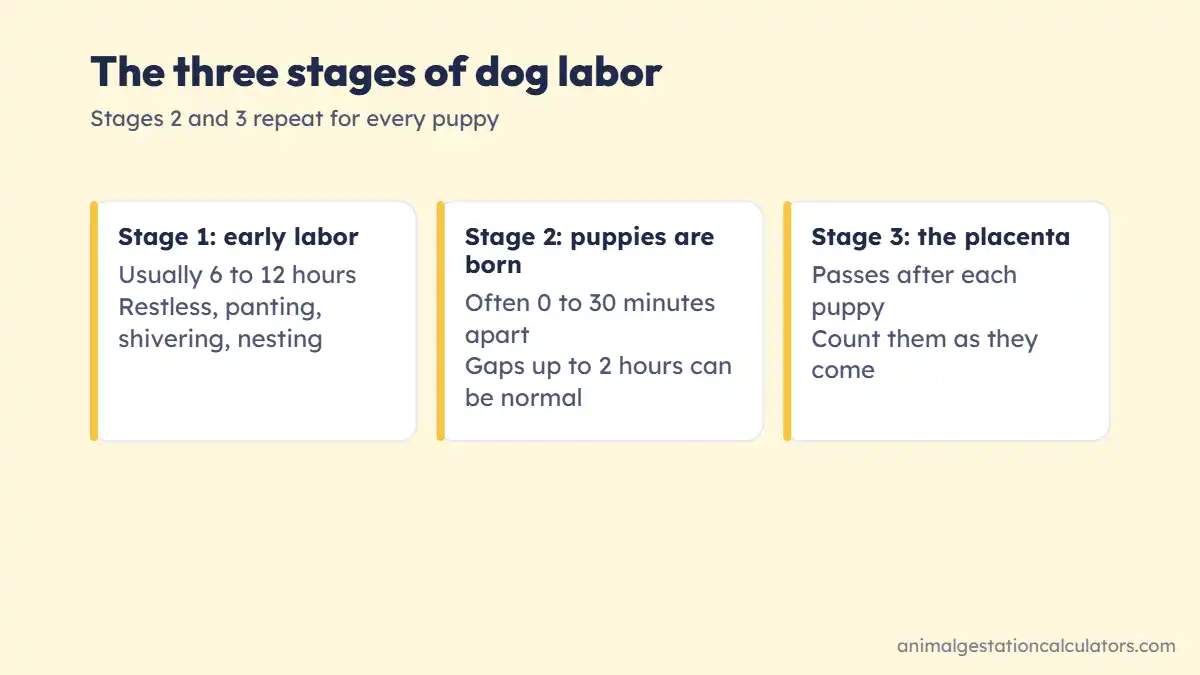
Dog labor has three stages. Stage 1 is the build-up, when the cervix opens. Stage 2 is when puppies are born. Stage 3 is the placenta passing. Stages 2 and 3 repeat for each puppy, so she moves back and forth between them until the last one arrives.
Stage 1: early labor
This stage usually lasts 6 to 12 hours, and up to a day or more in some dogs. She will be restless and may pant, shiver, vomit or nest. You may not see any pushing yet. Keep the room quiet and let her move around.
Stage 2: puppies are born
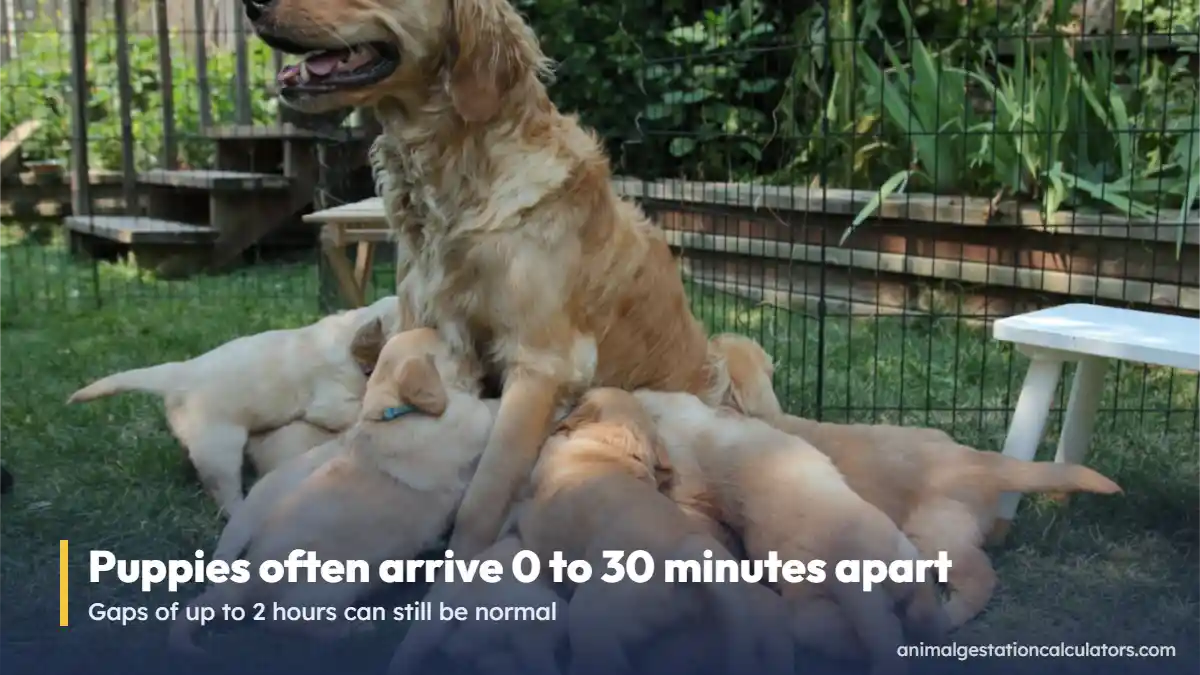
You will see clear, strong contractions and pushing. A fluid-filled sac often appears first, and a puppy follows. Puppies often come 0 to 30 minutes apart, and gaps of up to 2 hours can still be normal. Most dogs lick the puppy free of its sac and chew the cord.
Stage 3: the placenta
A dark placenta, or afterbirth, usually passes within 15 minutes of each puppy. Count them. A retained placenta can cause infection, so tell your vet if you count fewer placentas than puppies.
When should you call the vet during labor?
Call your vet if she strains hard for 20 to 30 minutes without a puppy, or if more than 2 hours pass between puppies while you know more are inside. Green discharge with no puppy soon after also needs a call. So does a temperature drop with no labor after 24 hours.
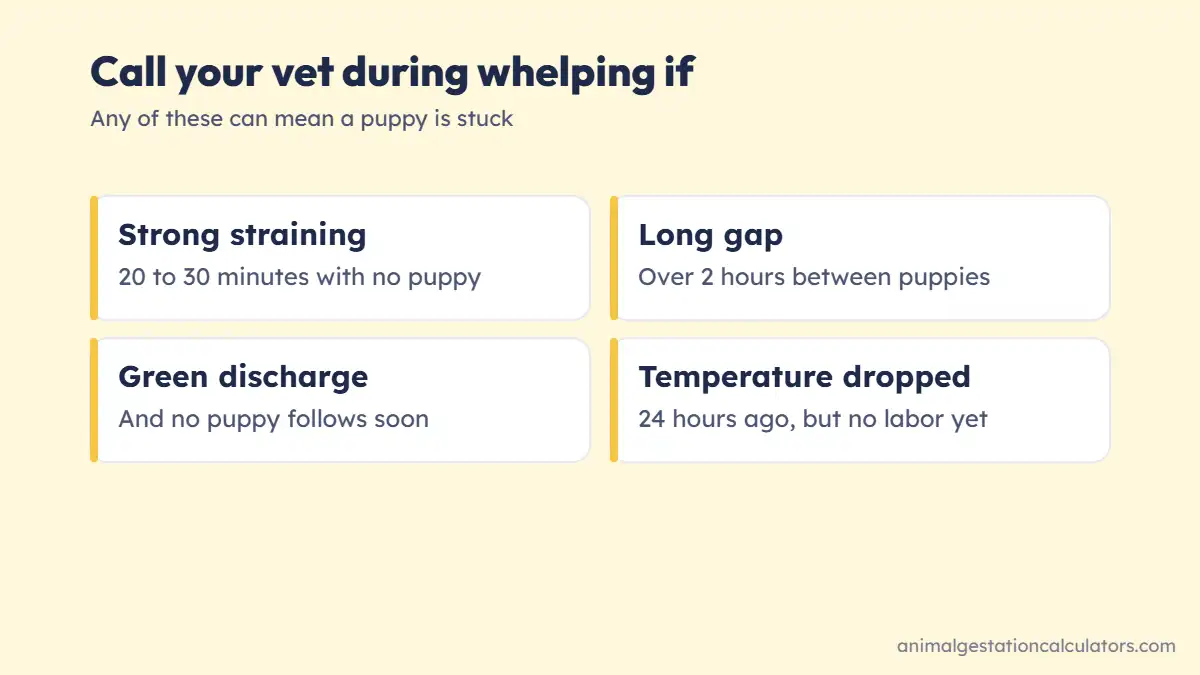
Also call if she seems very weak or in great pain, if there is a lot of bright red blood, or if it has been more than 72 days since mating with no signs at all. Cornell’s guide to the normal whelping process is a good page to read before the big day.
How do you know she has finished giving birth?
The surest way is to know the number of puppies from an X-ray taken late in pregnancy, then count them as they arrive. Without a count, signs that she is done include calm breathing, no more straining, and settling down to nurse and clean the puppies.
If you are unsure, your vet can check her by feel or with a quick X-ray. Our guide to how many puppies a dog can have explains how that count is done.
What happens after the puppies are born?
She should rest, eat and drink within a few hours and let every puppy nurse. A reddish-brown discharge called lochia is normal for about 3 weeks, and sometimes up to 8. Bad-smelling discharge, fever or a mother who won’t eat needs a vet visit.
Plan a vet check for her and the puppies within a day or two. If her pregnancy was a surprise, read the dog pregnancy week by week guide to see what the last weeks looked like. The dog pregnancy test guide explains when an X-ray count works best.
Frequently asked questions
Can a dog be in early labor for 24 hours?
Yes, especially with a first litter. Stage 1 usually lasts 6 to 12 hours but can stretch longer. If she has strong contractions and still no puppy after 20 to 30 minutes, call your vet.
Does a dog’s temperature always drop before labor?
It almost always does, but the drop can be missed. It lasts only about 8 hours. Taking readings twice a day from about day 57 gives you the best chance of catching it.
Is green discharge normal during whelping?
Green discharge means a placenta is separating, so a puppy should follow soon. If you see it and no puppy arrives quickly, call your vet.
Should I cut the umbilical cord myself?
Usually not. Most mothers chew the cord. If she doesn’t, ask your vet to show you how to tie the cord with thread about an inch from the belly and cut beyond the tie.
How long does a dog bleed after giving birth?
A reddish-brown discharge is normal for about 3 weeks and can last up to 8. It should slowly fade. Heavy bright red bleeding or a bad smell needs a vet visit.
Can I leave my dog alone while she is in labor?
It is best to stay nearby but out of her way. You need to time the gaps between puppies and spot trouble early. Check in quietly rather than hovering.